A patriotic warning from a person who has never met the threat, but has read a lot about it on Twitter
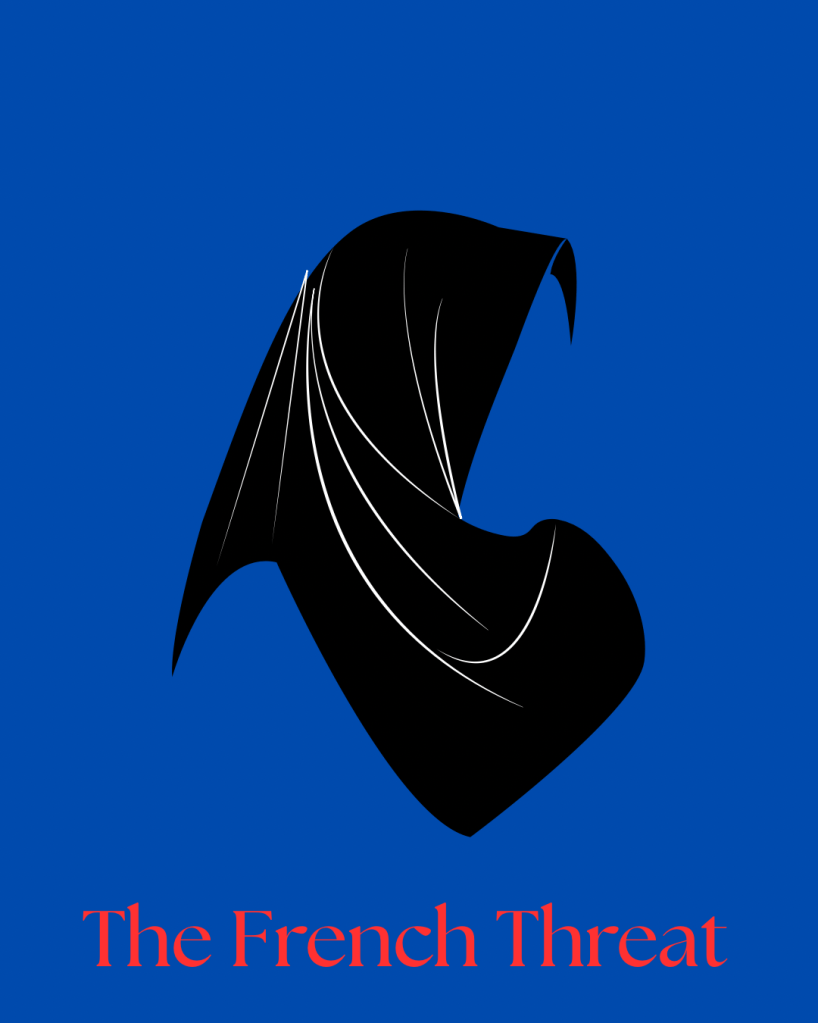
France has survived a great deal. Two world wars, the Hundred Years’ War (which lasted 116 years, a scandal in itself), and the day a Parisian waiter was polite to a tourist. But nothing has prepared the Republic for what is coming: a piece of fabric, roughly one metre long, worn on the head.
Some people will say I am exaggerating. Those people have clearly never looked at a scarf for long enough.
Pillar One: Identity
What does it mean to be French? Philosophers have debated this for centuries, but the answer is simple. To be French is to have visible hair. Voltaire had hair. Napoleon had hair, at least at the beginning. Johnny Hallyday had a great deal of hair, and he defended it until the very end.
Some will point out that Marianne, the very symbol of the Republic, wears a Phrygian cap. This is different. Her hat is revolutionary. Hers is a hat of freedom, not a hat of… other things. If you cannot tell the difference, you are simply not French enough to understand.
Others will mention our grandmothers, who wore headscarves to market every Saturday for sixty years. Again, different. Mamie’s scarf was tied under the chin, which is a Catholic knot. The threat ties it differently. I have not checked how exactly, but I am sure it is worse.
And let us not forget the beret, the balaclava in Chamonix in January, the nun’s veil, and the silk Hermès square that every woman in the 16th arrondissement wears to lunch. These are all heritage. Heritage is fabric that costs more than 300 euros.
The numbers, however, are terrifying. According to an Ifop survey published in November 2025, 45% of young Muslim women aged 15 to 24 now wear the veil, compared with 16% in 2003. Coincidentally, another 44% said they wear it so as not to attract men’s attention. The obvious answer, our lawmakers concluded, is for the state to pay very close attention to their heads. No equivalent survey exists on berets, which tells you everything you need to know.
Pillar Two: Security
Here the danger becomes truly frightening. What could be hiding under a hijab? Experts (me) have identified several possibilities: hair, ears, perhaps a hair clip. Worse still, thoughts. A covered head may be thinking anything at all, and the state has no way of checking.
This is exactly where our ancestors went wrong. As the scholar Michael C. Williams explains, the modern liberal state was born out of Europe’s wars of religion. Hobbes and Locke, traumatised by the Thirty Years’ War, decided that the state should judge what citizens do, not what they believe, and that threats should be measured in material terms while private convictions were left alone. Williams calls this “a negative identity practice”: keeping identity out of security precisely because it starts wars. A charming idea, and terribly naïve. Hobbes never had to share a métro carriage with a scarf. Modern France, thankfully, has learned to do the opposite. It measures a threat by what someone might believe, and it checks by looking at their head.
France has acted bravely so far. In 2004, we protected schools from headscarves. In 2010, we protected the streets from face coverings. In the summer of 2016, several mayors protected the beaches from burkinis, because nothing threatens national security like a woman who does not want sunburn. In 2023, the abaya was removed from schools, saving our children from long dresses.
But 2025 was the year the Republic finally woke up. In May, an Interior Ministry report on the Muslim Brotherhood and political Islam warned of a massive and visible rise in little girls wearing the veil. In December, Laurent Wauquiez and twenty-nine other Droite Républicaine deputies filed Proposition de loi n° 2167, which would have forbidden parents to impose on their minor daughter, or even allow her, a garment intended to hide her hair in public. Note the elegance: the bill simply adds one sentence to the 2010 law banning the concealment of the face. Had it passed, hair would have become legally part of the face in France. It did not: in January 2026, the Assemblée’s law committee threw it out before even looking at its single article. In a moment of terrible naivety, the deputies have left millions of French heads unsupervised, and history will not forgive them.
Even better, the 2010 law keeps its exceptions for health, work, sport, festivals and artistic or traditional events. So a twelve-year-old in a headscarf would have been a danger to the Republic on Tuesday, and perfectly acceptable at carnival on Saturday. Security is all about timing.
Some politicians found this far too timid. On 1 September 2026, Le Monde reported that the Rassemblement National wants to fine women who wear the veil in public, and Marine Le Pen promised a referendum on a great law against Islamist ideologies. On Franceinfo, RN deputy Jean-Philippe Tanguy explained that his party had never stigmatised veiled women, but that, “unfortunately, one must sometimes abandon a certain number of symbols.” He did not say whose symbols. I think we can guess.
The rest of the political class was horrified, mostly because each of them already has a smaller ban of their own. Bruno Retailleau, who wants the veil out of sports competitions and school trips, called the RN “populists” who “will break their promises” because the plan cannot be enforced. He is not against the idea, only the paperwork. Gabriel Attal declared himself in “radical disagreement”, in the name of freedom of belief and women’s choice, just a few months after proposing a ban for girls under 15. The French voter therefore faces a simple menu:
- Under 15: Attal
- Under 18: Wauquiez
- Sport and school trips, any age: Retailleau
- Everyone, with fines, by referendum: Le Pen
It is like choosing a phone contract, except the small print is your head.
Retailleau, to be fair, knows the danger up close. In February 2025, while still Minister of the Interior, he went on David Pujadas’s programme on TF1 and LCI and had a heated exchange about the veil with Lilia Bouziane, a law student who wears one. He had come to defend banning the veil at university and for mothers accompanying school trips, since, in his words, a school outing is “l’école hors les murs”, school outside the walls. By that logic, the whole of France is a school outside the walls, which would save everyone a great deal of time. He then assured her that he was not calling every veiled woman an Islamist, only pointing out that every Islamist wants women to wear the veil. A flawless syllogism: all pirates want treasure, therefore keep an eye on anyone with a savings account. She answered that there was no “grand barbu” standing behind veiled women telling them to cover up, urged him to stop treating Muslims like children, and said it was worrying to sell the French a fight against Islamism that consists of banning women’s veils. Note the danger here. Not only is the threat among us: it has studied law, it builds arguments, and it answers back on live television. The security situation is far worse than we thought.
What Must Be Done
I propose a few modest measures:
- A Ministry of Hair, responsible for checking that all French heads are visible, ventilated and secular.
- Wind detectors at every border. If a scarf moves in the breeze, it is a scarf. If it does not, it is suspicious.
- A national exemption list for approved head coverings: berets, Hermès squares, Marianne’s cap, motorcycle helmets, anything worn at carnival, and anything worn by Catherine Deneuve in the 1960s.
- A citizenship test in which candidates must explain, in under two minutes, why their grandmother’s scarf was fine.
Some critics claim that France has real problems: housing, unemployment, the price of a baguette in Paris. They say that politicians talk about women’s clothing to avoid talking about any of these. That is a cynical view, and probably foreign.
The truth is that a nation is only as strong as the things it is afraid of. Some countries fear invasion, some fear climate change. France, being France, has chosen something more elegant to fear: a scarf. And if we stand together, uncovered and united, we might just survive it.
Vive la République, et vive les cheveux.
Bibliography
La Grande Confrontation, LCI, 6 February 2025. (https://youtu.be/Jjo32GuXqOs)
Loi n° 2010-1192 du 11 octobre 2010 interdisant la dissimulation du visage dans l’espace public (France), https://www.legifrance.gouv.fr/loda/id/JORFTEXT000022911670.
Ministère de l’Intérieur, Frères musulmans et islamisme politique en France, Dossiers de presse, 2025). https://www.interieur.gouv.fr/actualites/dossiers-de-presse/publication-du-rapport-freres-musulmans-et-islamisme-politique-en-france
Williams, M. C., ‘Identity and the Politics of Security’, European Journal of International Relations, 4 (1998), 204–225.

