
By Kian Donovan
Hong Kong is, according to many of its residents, a city in decline. (1) In the aftermath of the 2019 Pro-Democracy Protests, Hong Kong has lost much of its autonomy and economic status, lending itself to mass-migration and feelings of existential death among Hong Kongers. (2) Similarly, Hong Kong’s iconic neon street signs have largely disappeared, depriving the city of a characteristic feature. Both losses are concerning, but they are more than just destructive— this article argues that, in the conscious acts to restore and defend a purportedly dying Hong Kong, the story of Hong Kong’s neon signage reflects the significant changes in the city’s identity in recent decades.
The 21st-century has seen significant changes in Hong Kong’s identity. At the time of the city’s handover in 1997, the Hong Kong and Chinese identities were largely parallel and compatible, with residents comfortably identifying as both Hong Konger and Chinese. (3) However, as coexistence brought changes to the city’s social and economic landscape, a new generation in the 2000s pursued an evolved sense of belonging in a world beyond the colonial era. (4) As Francis Lee and Chi Kit Chan contend, no identity can exist in a vacuum, and it was the Chinese “Other”—whose nature as outsider was afforded by Hong Kong’s distinct values and autonomy—against whom Hong Kongers built a new sense of self. (3,4,5) The PRC’s authoritarian ambition amid inflows of mainland business and tourism led to a heightened experience of the “Other”, strengthening this exclusive identity. (3)
With the economic and political costs that came after the handover, the discourse of the city began to assume a narrative of “disappearance” at the hands of China, becoming what Felix Berenskotter calls a “biographical narrative”, the shared understandings by which social groups create meanings of past, present, and future, often in order to mobilise collective action. (4, 6, 7) This new understanding manifested in the form of “localism”, a discursive and political movement centred around the defence of Hong Kong’s culture and autonomy, originating in 2006 with the protest campaign to preserve Hong Kong’s iconic Star Ferry Pier. (4, 8) In the protest movements of the 2010s, the defence of Hong Kong identity was utilised as a rallying call to encourage participation while the identity itself was shaped and strengthened by the collective experience of protest and oppression, fortifying this collective subjectivity and heightening a sense of distinct self. (4, 9, 10, 11)
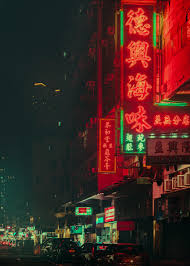
Hong Kong’s neon has also found itself reflected in this new biographical narrative. Throughout Hong Kong’s 20th-century heyday, the city’s vibrant neon skyline served as one of its key identifying traits. (12) As M+ Museum curator Aric Chen puts it, “Neon has been the light of the city for a really long time, you couldn’t escape from it. You saw Hong Kong through neon lighting or because of neon lighting”, and it is “indelibly linked to what the city is in popular imagination.” (12) Businesses large and small took pride in their signage, hoping they would be passed down through the generations, and the “bigger is better” message sent by the ostentatious signs reflected the city’s vibrant business growth.(1, 13, 14) In the last twenty years, however, 90% of Hong Kong’s neon signs have disappeared off the streets, in large part due to economic reasons—LED lights are much cheaper, and many neon craftspeople shut down due to low demand or migrated towards the cheaper labour and operating costs of the mainland. (13, 15) Furthermore, starting in 2010, the city began issuing much stricter safety rules and making the approval process for installing and maintaining neon signs far more difficult. (13, 15)
But this “death” of neon sparked a localist push to maintain this key part of Hong Kong’s history. In contrast to a pre-1997 Hong Kong that lacked nearly any resistance to urban renewal, the localist cause has energised the valuation of the city’s cultural heritage. (16) Hong Kongers now exhibit strong desire to preserve the remnants of their purportedly dying city—including neon, the symbolic exemplar of wistfulness for days gone. (1, 5, 17) Neon preservation efforts now see increasing support from organisations like Hong Kong Neon Heritage Group, Tetra Neon Exchange, and the M+ Museum. (2, 13) Neon craftspeople are gaining new traction from private industries capitalising on newfound demand, while dedicated social media pages like @streetsignshk bring attention to neon throughout the city. (2) Thus, Hong Kong’s purportedly dying neon landscape is experiencing new life as a cherished cultural bastion, a reflection and manifestation of the way localism has brought new vigour and meaning to Hong Kong identity.
Bibliography
- Lunn, Oliver. “Sign of the Times: Hong Kong Rages against the Dying of Its Neon Lights.” VICE, 27 July 2024, http://www.vice.com/en/article/hong-kong-neon-signs/.
- Sze, Chloe. “Hong Kong’s Neon Glow Dims, Symbolising the End of an Era.” Global Voices, 23 Aug. 2024, globalvoices.org/2024/08/22/hong-kongs-neon-glow-dims-symbolising-the-end-of-an-era/.
- Lee, Francis Lap Fung, and Chi Kit Chan. “Political events and cultural othering: Impact of protests and elections on identities in post-handover Hong Kong, 1997–2021.” Journal of Contemporary China 33, no. 147 (2024): 417-431. 429
- Chan, Stephen CK. “A Hong Kong critique of identity: Belonging and becoming in the aberrant post-colony.” Situations 13, no. 2 (2020): 169-197. 171, 181
- Lu, Tracy L.-D. 2009. “Heritage Conservation in Post‐Colonial Hong Kong.” International Journal of Heritage Studies 15 (2–3): 258–272.
- Yan, Huen Wai. “Miroslav Volf’s theology of embrace, vernacular cosmopolitanism, and the disappearance of Hong Kong identity.” Practical Theology 15, no. 3 (2022): 228
- Berenskoetter, Felix. “Parameters of a National Biography.” European Journal of International Relations 20, no. 1 (2014): 288.
- Kwong, Ying-ho. “The Growth of “Localism” in Hong Kong. A new path for the democracy movement?.” China Perspectives 2016, no. 2016/3 (2016): 63-68.
- Ortmann, Stephan. “Hong Kong’s constructive identity and political participation: Resisting China’s blind nationalism.” Asian Studies Review 45, no. 2 (2021): 321
- Larsson, Jessika. “Hong Kong in Transition: The Hong Kong identity and value change in relation to the pro-democracy protests of 2003-2020.” (2021).
- Adorjan, Michael, Paul Vinod Khiatani, and Wing Hong Chui. “The rise and ongoing legacy of localism as collective identity in Hong Kong: Resinicisation anxieties and punishment of political dissent in the post-colonial era.” Punishment & society 23, no. 5 (2021): 650-674.
- Fernández, Eduard. “Hong Kong’s Fight to Save Its Neon Shimmer – a Photo Essay.” The Guardian, Guardian News and Media, 25 July 2018, http://www.theguardian.com/travel/2018/jul/25/hong-kong-neon-lighting-threat-chinese-regulations.
- Leung, Hillary. “‘It’s Disappearing Very Fast’: Hong Kong’s Fading Neon Heritage Shines a Spotlight on the Craft.” Hong Kong Free Press HKFP, 20 Jan. 2024, hongkongfp.com/2023/04/16/its-disappearing-very-fast-hong-kongs-fading-neon-heritage-shines-a-spotlight-on-the-craft/.
- Chan, Bernice. “Why Hong Kong’s Iconic Neon Lights Have All but Disappeared.” Goldthread, Goldthread, 21 July 2019, http://www.goldthread2.com/travel/hong-kong-fading-neon-lights/article/3019495.
- Rathod, Aalok. “The Gradual Death of Neon Lights in Hong Kong.” Medium, Medium, 11 Nov. 2018, medium.com/@aalokrathod/the-gradual-death-of-neon-lights-in-hong-kong-8585beb1dbad.
- Lu, Tracey L.-D. “Empowerment, Transformation and the Construction of ‘urban Heritage’ in Post-Colonial Hong Kong.” International Journal of Heritage Studies : IJHS 22, no. 4 (2016): 325–35. 334
- Chen, Yun-chung, and Mirana M. Szeto. “The forgotten road of progressive localism: New preservation movement in Hong Kong.” Inter-Asia cultural studies 16, no. 3 (2015): 436-453

