

By Mingchen Zhao
The conflict between the Han Chinese and Uyghurs is the most serious ethnic conflict in China. Since the 2009 Urumqi riots, hatred of Han towards the Uyghurs has intensified. Meanwhile, the Han have maintained peace with the other major ethnic minorities: the Tibetans, Hui, Manchus and Mongols. In history, there were bloody conflicts between the Han and these ethnic minorities, such as the Mongols and Manchus’ conquests and the Hui and Tibetans’ rebellions. Today, however, why do the Han hate the Uyghurs the most? This article will analyse this unfairness from the perspectives of genetics and religion.

Genetic research in molecular anthropology explains the relationships between ethnic groups. The Han Chinese’s concern with race and genetics stems from historical tradition. In history, the dynasties established by the Han have been hegemonic in East Asia, marked by the Han and Tang dynasties. This legacy has given the Han a sense of pride and exclusivity. Like the Romans, the Han are willing to call other races barbarians. The ancient classic Zuo Zhuan’s saying, ‘People of a different race cannot be trusted’, reflects this xenophobia among Han Chinese.
According to Figure 1, the Han share genes K2, K3, K5 and K7 with the Hui and Manchu (K1-K8 represent different Asian genomes), and differ from the Mongolian only in the K3 gene’s proportion (Cao et al., 2020). Genetic origins’ similarity gives these people a sense of familiarity in appearance and makes them geographically close to each other. Many Han people live in Inner Mongolia (Mongolian), Manchuria (Manchu) and the northwest (Hui). After long coexistence and intermarriage, these people have nearly no differences in appearance or living habits.
However, Uyghurs and Tibetans are genetically distinct from Han Chinese. Uyghurs, according to Figures B and C, have ancestors and genes from West Eurasia (33.3%), East Asia (32.9%), South Asia (17.9%) and Siberia (16.0%) (Feng et al., 2017). In contrast, Han Chinese genes originated almost entirely in East Asia (Cao et al., 2020). The genetic differences between Han and Uyghur have created antagonism in appearance and prevented ethnic understanding and integration. Tibetans face similar problems, but why are Han-Tibetan conflicts not fierce? This article will consider the factors of religion.
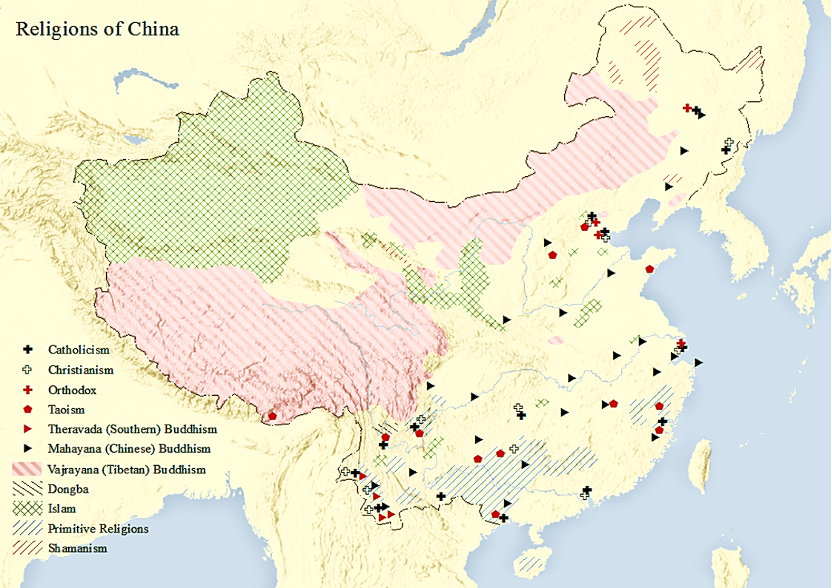
Figure D. Chinese religions distribution
Religion is another factor that influences Chinese identity. All China’s ethnic minorities have their own beliefs, some of which are accepted by the Han, while others are not. The religious principle of the Han is syncretism and integration, i.e. Confucianism, Taoism, Buddhism and folk beliefs coexist as syncretism (a religious harmony and unification) (Sun, 2016). This leads to the Han accepting the local religions of most ethnic minorities. For example, Tibetan Buddhism, which is practised by Tibetans, Mongolians and Manchus, are accepted by the Han. Historically, Tibetan Buddhism was widely practised by Manchu and Han officials as the imperial religion of the Qing dynasty (the Gelug school). Even today, there are Tibetan Buddhist temples all over China, such as the Yonghegong Lama Temple in Beijing.

Figure E. Yonghegong is a famous temple and scenic spot.
Islam is different. It is an imported religion and has not been accepted by Han Chinese throughout history. Among the ethnic minorities in China, Islam is widely practised by the Hui and Uyghur people, but Han Chinese’s attitude towards these two groups also differs. The Hui people are essentially Han Chinese who have been Islamised. As mentioned earlier, genetically, there is no difference between the Hui and Han. Moreover, apart from dominating the relatively small province of Ningxia, the Hui people exist in other provinces as diasporic communities. Small Hui communities are established around mosques and distributed independently in different cities. Therefore, the Hui’scommunities and religion are considered manageable and not threatening in terms of scale. However, more than 10 million Uyghurs are living in Xinjiang (Klimeš, 2018). The scale of their communities and religion is too large for the Han Chinese to control, so they become a threat to the Han.
| Manchu | Mongolian | Hui | Tibetan | Uyghur | |
| Gene | Accept | Accept | Accept | Discriminate | Discriminate |
| Religion | Accept | Accept | Discriminate | Accept | Discriminate |
Figure F. Han Chinese attitude towards ethnic minorities
In conclusion, this article has analysed the similarities between the Han Chinese and ethnic minorities at both the genetic and religious levels. Genetically, the Manchu, Mongolian and Hui are like the Han; the Manchu, Mongolian and Tibetan religions are also accepted. However, only the Uyghur people are different from Han Chinese in both respects and are therefore discriminated against. (750 words)
Reference
Cao, Y., Li, L., Xu, M., Feng, Z., Sun, X., Lu, J., Xu, Y., Du, P., Wang, T., Hu, R., Ye, Z., Shi, L., Tang, X., Yan, L., Gao, Z., Chen, G., Zhang, Y., Chen, L., Ning, G., … Wang, W. (2020). The ChinaMAP analytics of deep whole genome sequences in 10,588 individuals. Cell Research, 30(9), 717–731. https://doi.org/10.1038/s41422-020-0322-9
Feng, Q., Lu, Y., Ni, X., Yuan, K., Yang, Y., Yang, X., Liu, C., Lou, H., Ning, Z., Wang, Y., Lu, D., Zhang, C., Zhou, Y., Shi, M., Tian, L., Wang, X., Zhang, X., Li, J., Khan, A., … Xu, S. (2017). Genetic History of Xinjiang’s Uyghurs Suggests Bronze Age Multiple-Way Contacts in Eurasia. Molecular Biology and Evolution, 34(10), 2572–2582. https://doi.org/10.1093/molbev/msx177
Sun, A. (2016). The Study of Chinese Religions in the Social Sciences: Beyond the Monotheistic Assumption. Religion and Orientalism in Asian Studies, 51-72.
Klimeš, O. (2018). Advancing “Ethnic Unity” and “De-Extremization”: Ideational Governance in Xinjiang under “New Circumstances” (2012–2017). Journal of Chinese Political Science, 23(3), 413–436. https://doi.org/10.1007/s11366-018-9537-8
 Identity Hunters