
By Hannah Jung
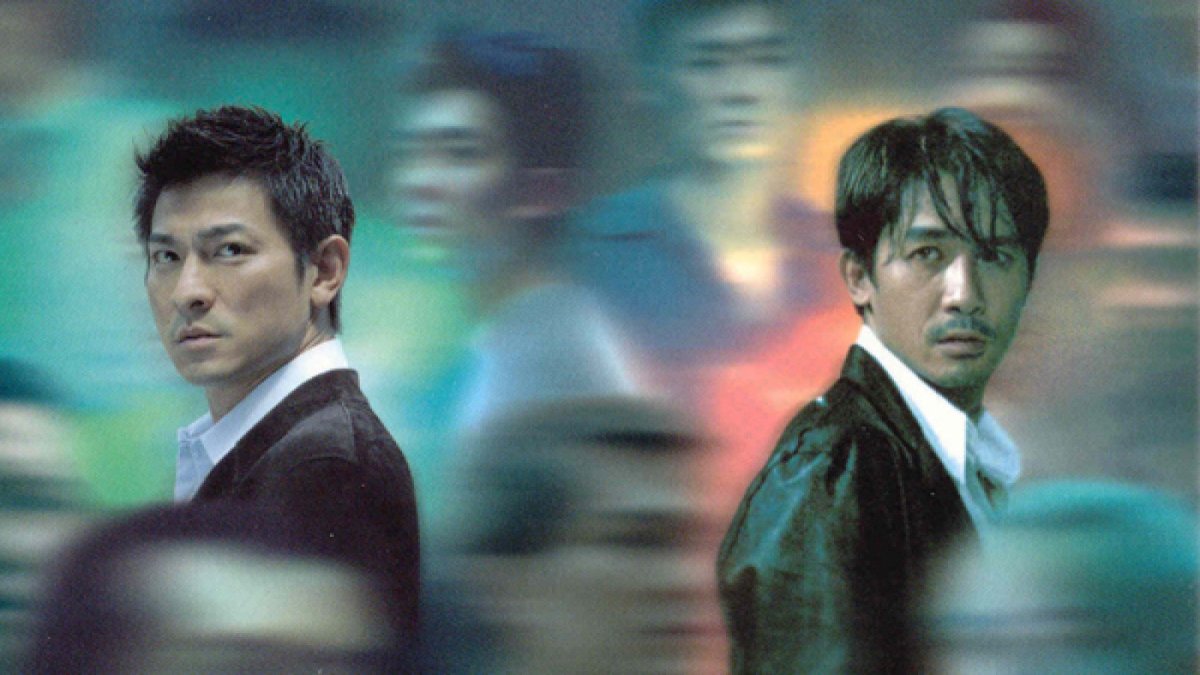
“The worst of the eight hells is continuous hell – it has the meaning of Continuous Suffering.” The 2002 action thriller Infernal Affairs opens with this unsettling verse from the Nirvana Sutra. It turns to the drug lord Hon Sam recruiting Lau Kin-ming as his mole in the police, while Superintendent Wong Chi-shing appoints Chan Wing-yan as an undercover operative in Hon’s triad. Both men navigate a web of lies and truth in search of legitimacy. This story of continuous hell mirrors Hong Kong’s postcolonial identity crisis, as it struggles to claim a destined, singular identity.
Infernal Affairs illustrates one society under two systems, the triad and the police force – a division that closely reflects Hong Kong’s reality. The film’s portrayal of pre-1997 police force as the law enforcer of the British colonizers represents Hong Kong’s colonial past. The triad, on the other hand, serves as the countering force of domestic influence and Chinese nationalityafter the 1997 handover.1 This duality, however, reveals more than a moral dichotomy, but the fluid and slippery nature of Hong Kong identity.2 The tension of dual identities is particularly pronounced in the city as it has long experienced an identity vacuum. Before colonization, it lacked a solid form of national governance or strong connections with the Chinese Emperor. This malleable space allowed British colonial influence to shape much of its way of life.3 Yet, China’s sovereignty over Hong Kong presents an unchallengeable reality that delegitimizes entrenched foreign influence. The city finds itself in a predicament of irreconcilable identity duality which Howard Choy describes as “Schizophrenic Hong Kong”.4
The film takes a dramatic turn as the ambitious pursuit of victory eventually costs Wong and Hon their lives. With their superiors gone, Lau and Chan are left to determine their own fate. Lau desperately seeks to become a real policeman, a true “good guy”, while Chan strives to reclaim his identity. This cinematic progression symbolizes a contextual transformation – the end of Hong Kong’s colonial era and its anxious attempt to reincarnate its true Chineseness.5
This journey is grueling. Chan uncovers Lau’s infiltrator identity and resolves to bring him to justice. But, without Lau’s authentication, now Wong’s successor, Chan’s police identity cannot be recovered. They are once again caught in the schizophrenic struggle of dual identity. Released in 2002, Infernal Affairs reflected the repercussions (or continuation) of Hong Kong’s identity crisis amid the SARS epidemic and financial downturn. Though decolonized, these crises shook public confidence in the newly established HKSAR government and their relations with the mainland. This uncertainty fueled nostalgia for colonial Hong Kong as a thriving international business center.6 An “existential agony” was presented in the psycho-socio dynamics, which the city struggled to embrace the supposedly incontestable Chinese nationality while departing from its colonial past.7
The famous rooftop scene shows Lau and Chan confront each other after discovering their true identities. Chan’s attempt to arrest Lau fails when he is shot by Lau’s hidden triad accomplice, Inspector B, sealing his last chance at returning to his original and singular identity. Lau then kills B, rejecting his triad past but failing to achieve the righteousness needed to justify his legitimacy as a policeman. Trapped in a life of lies, enduring the schizophrenic struggle of identity, he serves as an allegory for Hong Kong. Unable to return to its Chinese identity psychologically, the city is caught between reconciling and resisting its duality in a “continuous hell” of identity crisis.8
Infernal Affairs suggests a destiny of Hong Kong intrinsically linked to its identity pluralism. However, this socio-political hybridity does not imply a hierarchical comparison between Chinese and foreign cultures. Rather, as Sheldon Lu argues, the vital question concerns Hong Kong’s agency and what it means to be a Chinese or Hong Konger.9 Like the film’s final scene, where Lau whispers “I do” at Chan’s funeral – signifying his desire to trade fates with Chan and become a truly righteous man – this moral awakening redefines his double life, transforming his mission into redemption.
References
- 1 Howard Y. F. Choy, ‘Schizophrenic Hong Kong: Postcolonial Identity Crisis in the Infernal Affairs Trilogy’, Transtext(e)s Transcultures: Journal of Global Cultural Studies, no. 3 (2007), 59.
- 2 Gina Marchetti, Andrew Lau and Alan Mak’s Infernal Affairs – The Trilogy (Hong Kong, 2007), 95.
- 3 Steve Tsang, Governing Hong Kong: Administrative Officers from the Nineteenth Century to the Handover to China, 1862-1997 (Hong Kong, 2007), 1-2.
- 4 Choy, 52.
- 5 Choy, 59-60.
- 6 Vivian P. Y. Lee, Hong Kong Cinema Since 1997: The Post-Nostalgic Imagination (London, 2009), 139-40.
- 7 Choy, 53-6.
- 8 Choy, 58.
- 9 Sheldon Lu, ‘Filming Diaspora and Identity: Hong Kong and 1997’, in David Desser and Poshek Fu (eds.), The Cinema of Hong Kong: History, Arts, Identity (Cambridge, 2000), 285.
Bibliography
1. Choy, Howard Y. F., ‘Schizophrenic Hong Kong: Postcolonial Identity Crisis in the Infernal Affairs Trilogy’, Transtext(e)s Transcultures: Journal of Global Cultural Studies, no. 3 (2007), 52–66.
2. Lee, Vivian P. Y., Hong Kong Cinema Since 1997: The Post-Nostalgic Imagination (London, 2009).
3. Lu, Sheldon, ‘Filming Diaspora and Identity: Hong Kong and 1997’, in David Desser and Poshek Fu (eds.), The Cinema of Hong Kong: History, Arts, Identity (Cambridge, 2000), 273–88.
4. Marchetti, Gina, Andrew Lau and Alan Mak’s Infernal Affairs – The Trilogy (Hong Kong, 2007).
5. Tsang, Steve, Governing Hong Kong: Administrative Officers from the Nineteenth Century to the Handover to China, 1862-1997 (Hong Kong, 2007).
 Identity Hunters