
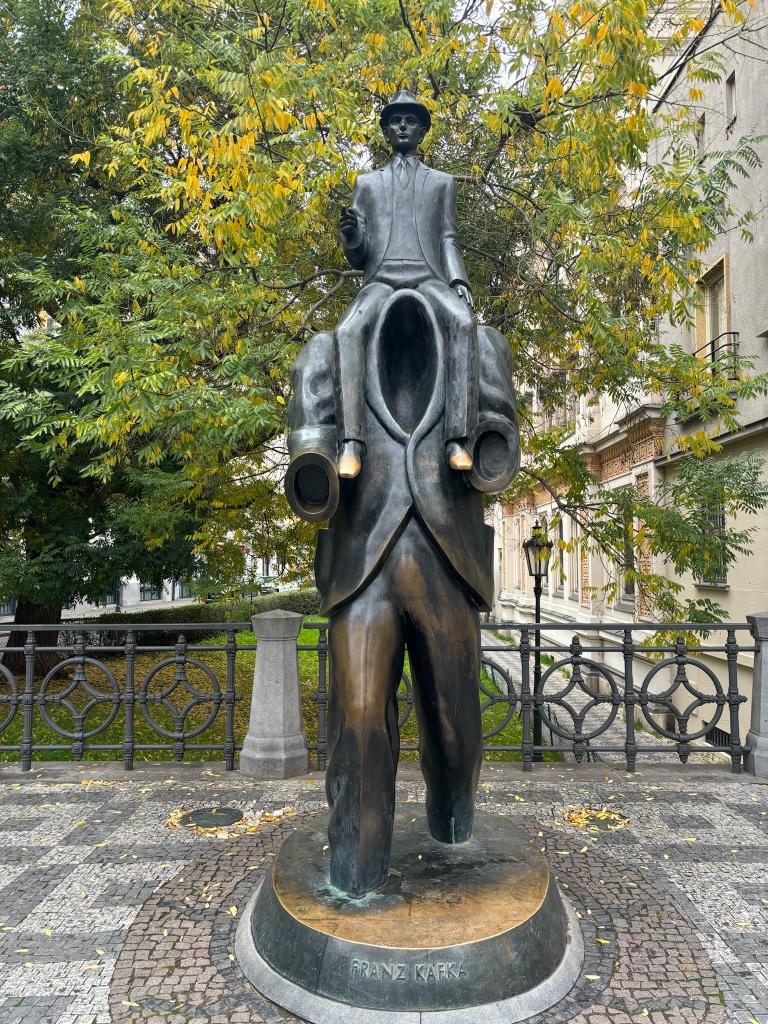
Written by Lucetta Trascinelli
As a human-turned-beetle, the character of Gregor Samsa in The Metamorphosis offers an introspective understanding of his writer, Franz Kafka, and the deep frustrations he faced regarding the question of identity. What seems simply to be a story of a troubled author is, in reality, a much more complex and intricate history of contemporary ethnic and national tensions, with underpinnings of religion, that continuously clash and come together. Therefore, to understand Kafka and, in turn, his expression of identity struggle via the metaphorical scenario of a cockroach-being, it is first necessary to delve into the historical context…
Europe, at the turn of the 19th century, was undergoing tumultuous changes politically, culturally, religiously, and intellectually. Particularly, the Austro-Hungarian Empire, into which Kafka was born, underwent dramatic change. The Empire was divided between the Austrian Cisleithania and Hungary, the former containing the Kingdom of Bohemia, where Franz Kafka was born. With 11 different nationalities and many more ethnicities, it was certainly not a simple scenario. Although the majority were Germans, Hungarians, and Czechs, a multi-ethnic empire without a cohesive national identity further imperilled it, leaving space for socio-political tensions to develop. (Classon, 32, 33)
Above all, language, which was initially a mere tool of communication, rapidly became a political weapon to symbolise division and ethnic belonging. (Herz, 302) Additionally, the nationalist sentiments proclaimed by the different national groups that pervaded throughout the Empire concurrently brought an increasing sentiment of antisemitism. As identity became increasingly politicised, concealing parts of one’s identity became a common characteristic of the changing environment. This struggle was particularly felt by the Jewish population in each part of the Empire. Although Jews were emancipated in 1849 and collectively endeavoured to assimilate and integrate into local national identities, society did not hesitate to ostracise them, often using them as scapegoats for national problems. The tension between Gentiles and Jews grew, and as time progressed, nationalist ideologies grew more potent, and the concept of identity narrowed. (Classon, 19) As the Austro-Hungarian Empire dissolved in 1918, nationalist sentiments developed further, creating an increasingly convoluted environment where chauvinist nationalism would create tensions between the different nationalities and religions. In Bohemia, Kafka’s native region, Germans and Czechs represented a strong rivalry which, nevertheless, united in recognising the Jews as a common enemy. (Sokel, 841) The contemporary historical background, therefore, reveals a complex framework where interwoven ethnicities, traditions, and religions, caused strong and problematic tensions.
Given the entangled nationalities and multi-ethnic population, situating oneself in a confined identity in Austria-Hungary at the turn of the century was not simple. Where would Kafka belong? This puzzling question undoubtedly left him confused and remains debatable to this day.
The effect of living in a multi-ethnic empire (which eventually dissolved largely due to growing nationalism) is clearly seen in Kafka’s struggles. These were certainly shared by many others like him, although his experience translated into his literary work.
Though effectively being an Austrian citizen, Kafka never expressed identifying with an Austrian identity. Whilst Kafka was born into a middle-class German-speaking assimilated Jewish family in Bohemia, due to the growing tensions and antisemitism, he felt repudiated from the society in which he grew up, leading to a feeling of isolation and the necessity to suppress his identity. Kafka also knew the Czech language, though he was conditioned by his family to renounce a complete assimilation to the Czech nation despite holding a positive attitude towards it and its culture. (Herz, 307)
Though feeling disliked and marginalised for his Jewish identity, Kafka later did not relinquish attempts to express his Jewish identity and pursued Jewish studies and Hebrew. Kafka also attempted to explore parts of the Yiddish identity, growing particularly fond of Yiddish theatre and literature. Although the Yiddish ancestry derived from his father, the latter repudiated Kafka’s interest in this and in Jewish writing, thus further complicating his personal complexities with identity and nationality. (Elwell)
This struggle is especially seen through Kafka’s literary work. A notable example is The Metamorphosis, where the reader can see how Kafka demonstrates introspection on his identity crisis via the main character and demonstrates the struggles of his reality. The Metamorphosis is in itself a metaphorical representation of Kafka’s personal struggle, isolation, and the alienation of the assimilated Jew community as a whole. Right from the beginning, the reader witnesses the transformation of Gregor Samsa (the main character) into a horrible vermin and how quickly his own family and society repudiate him . In this famous work, the reader recognises the importance of language and expression for Kafka, who ultimately felt constrained, almost unable to truly express himself (Classon, 60):
“Gregor was startled when he heard his own voice in reply; no doubt, it was unmistakably his previous voice, but merging into it as though from low down came an uncontrollable, painful squealing which allowed his words to remain articulate literally for only a moment, then stifled them so much as they died away that you couldn’t tell if you’d heard them properly…”
Franz Kafka, The Metamorphosis
This passage is analogous to the experience of assimilated Jews in 20th-century Prague: they can attempt to assimilate at the cost of relinquishing their voice, which goes unheard as they struggle to be part of society. The assimilated Jews, like Gregor, remain misunderstood and excluded from society. (Classon, 61) Unlike Gregor, though, what Kafka struggled most to achieve was an honest expression of his frustrations, especially to his family (and particularly his father). Indeed, although Gregor is seemingly rejected by everyone, he does in the end embrace his newfound identity as a bug:
The tremendous world I have in my head. But how free myself and free it without being torn to pieces. And a thousand times rather be torn to pieces than retain it in me or bury it. That, indeed, is why I am here, that is quite clear to me.
Franz Kafka, The Metamorphosis
Kafka’s struggles with his own identity following an upbringing in an environment of complex cultural, political, and national ties, which not only led him to feel unaccepted by society but also unable to fully find his place in any of the identities he belonged, whether it was Austrian, Czech, German or Jewish.
Indeed, Kafka was a figure amongst many who severely struggled with identity as a consequence of a mixed sense of belonging and duty of belonging. The notable literary works by Kafka offer a clear understanding of one such case of confusion in regard to identity, where religion and nationality intertwine to produce an unavoidably confused individual.
A legacy of alienation and confused identity continues beyond Kafka’s death, whereby admirers and critics of Kafka cannot place him in a confined identity or nationality. Although being thought of as a Czech writer, many Czechs do not recognise him as such and instead attribute him to German literature (Meisler)…yet again, Kafka remains alienated, in a limbo of unknown identity, rejected by some and accepted by others.
Bibliography
Boa, Elizabeth, “Chapter 2: Modernity and its Discontents Questions of Identity”, Kafka: Gender, Class, and Race in the Letters and Fictions, (1996), 23-44 https://academic.oup.com/book/25778
Classon, Sarah B., “Kafka’s Identity Crisis: Examining The Metamorphosis as a Response to Anti-Semitism and Assimilation in Turn- of-the-Century Europe” (2014). Master of Liberal Studies Theses. 50. http://scholarship.rollins.edu/mls/50
Elwell, Mina, Franz Kafka’s Tragic Real-Life Story. https://www.grunge.com/484409/franz-kafkas-tragic-real-life-story/
Herz, Julius, “Franz Kafka and Austria: National Background and Ethnic Identity”, Modern Austrian Literature, (1978) vol. 11 no.3/4, 301-318 https://www.jstor.org/stable/24645937
Meisler, Stanley, Franz Kafka Wrote in German : Czechs Pay Scant Homage to Their Greatest Writer, (1987), https://www.latimes.com/archives/la-xpm-1987-07-06-mn-1310-story.html
Sokel, Walter, “Kafka as a Jew”, New Literary History, (1999) Vol. 30, No. 4, 837-853 https://www.jstor.org/stable/20057574
 Identity Hunters