
Written by Lara Defterios
The fez, or tarboosh (طربوش) in Arabic, is a hat in the shape of a truncated cone or short cylinder, typically made with red felt or kilim fabric and a tassel. It is named after the city of Fez, in Morocco,
traditionally home to the crimson berries used to make the hats dye. Interestingly, the invention of synthetic aniline dyes commercialised their production in France, Germany, and Austria in particular.
And while its origins are complex, and it is home to many cultures across the Middle East and North Africa, the fez was introduced to Turkey in the early 19th century by Sultan Mahmud II. A symbol of
equality among Ottoman subjects, it was part of a series of reforms aimed at strengthening the empire’s military and political stability. And yet less than a century later, Mustafa Kemal Atatürk, the country’s first President, banned the fez on November 25, 1925. As a remnant of the Ottoman Empire, the hat was seen to be preventing Turkish citizens from assimilating with their Western counterparts. So, Atatürk’s ‘Hat Law’, still part of the Turkish Penal Code today, banned the fez in public places and replaced it with Western-style hats, enforced in some cases through the death penalty. The way in which the fez came to embody both modernity and regression in so short a time frame is complex, and has its roots in Ottoman reforms of the 19th century.
During the Ottoman Empire, the fez was introduced during a period of significant modernization and reform. In 1829, Sultan Mahmud II announced that the hat was to be worn by all Ottoman officials
regardless of religion. Indeed, it was the most important feature of what historian Donald Quataert termed the clothing revolution of Sultan Mahmud II, which saw military uniforms adapted to the French style, and civil servants encouraged to don European suits and starched shirts. The fez was undoubtedly a break from the past; since the 16th century, laws had dictated the clothing of Ottoman subjects, primarily to distinguish non-Muslims, such as Christians and Jews, from Muslims. But the hat was also the precursor to a deeper, more fundamental change. Alongside the economic modernity brought about by the Industrial Revolution, liberalism and constitutionalism had emerged and prospered in Europe. These developments, and their proximity to the Ottoman Empire, posed an imperial dilemma that sought to balance a traditional hold on power with ensuring political and economic stability. Thus, there began to exist a
consensus among the Ottoman elite, including Sultan Mahmud II, that reform was necessary to meet and survive modern challenges. Integral to this was the assertion of an Ottoman identity, halk, rooted in a love of country, vatan. The fez thus became a sartorial symbol of a rather secular Ottoman citizenship, and was generally received as such by non-Muslims in particular.
However, this same symbol of modernity came to be regarded as antiquated almost exactly a century later. From November 25, 1925, the fez was strictly prohibited to be worn in public places, with Turkish
citizens instead encouraged to wear Western-style hats alongside Oxford shoes and collared shirts. It was enforced unsparingly; when protests erupted in Erzurum, martial law was declared, opponents were detained, and 13 were executed. Opposition to the Hat Law in Rize, Sivas, Maras, and Kayseri was met with a similar tolerance by Independence Tribunals. As in the previous century, the fez stood for something more. Mustafa Kemal Atatürk came to power when the Turkish Republic was proclaimed on October 29, 1923. His Kemalism, as it came to be known, was the dominant iteration of Turkish nationalism that characterised his rule with Six Principles. Of these, Reformism is the most relevant to the Hat Law. Reformism maintained that to construct a modern nation-state, Turkish society and culture had to change. It is a core aspect of state-led nationalism, which seeks both to reform the new nation-state and modernise and unify people it deems ‘backward’. And so, with regards to Europe, Reformism was deeply bound up with westernisation that, for instance, saw the introduction of the Latin alphabet, for instance. When applied to the fez, this principle functioned by deeming the hat as a barrier to Turks’ assimilation with the Europeans that Atatürk aimed to imitate. The fez, therefore, was especially problematic for him because it was a symbol of the country’s Ottoman past, leaving little room for it to exist as an element of Turkish culture.
This rejection of the past, though, ignores the continuity and similarities that existed between Turkey and the Ottoman Empire. Indeed, concerns about modernisation and westernisation were evident far before Atatürk came to power. Among the introduction of the fez, reformist Sultans brought about the Tanzimat reforms, the first of which guaranteed all subjects equal legal protection in 1839, known as the Hatt-i Sherif of Gulhane. And while fiercely opposed in practice, the 1856 Hatt-i Hümayun, this time a result of European pressure, declared Muslims and non-Muslims equal in the eyes of the law. In this light, Atatürk’s assertion that the Ottoman Empire, and the fez associated with it, was backward, ignores its complex history. It also lends itself to a rather Orientalist reading of the Ottoman story that the “Sick Man of Europe” was in a state of inevitable decline from the seventeenth century. This is now challenged by revisionist historians, who recognize the reformist Sultans’ efforts to adapt the imperial system to modern challenges. Sultan Mahmud II’s sentiment, which no doubt influenced the fez’s introduction, reflects this: “From now on I do not wish to recognize Muslims outside the mosque, Christians outside the Church, or Jews outside the synagogue.”
Ultimately, the hat reflected a tension between tradition and modernity that Atatürk sought to decisively resolve in his construction of a Turkish nation-state. Though a thoroughly secular piece of clothing, fez fell victim to a Reformism that sought to shatter any remnants of the Ottoman-Islamic legacy in pursuit of this unified Turkey. This modernization echoed the concerns of the previous empire, namely its relationship with the west, but in the form of statehood as the principal political unit. The rejection of the fez, among many features of Turkish culture, served to construct a break between the Ottoman past and Turkish future. It simplified historical narratives that were otherwise less clear; Atatürk himself was very much part of the Ottoman political system, known for his role in defeating the British at Gallipoli in 1915.
This is a pattern observed in Eastern nationalism more widely, which struggles to resolve the tensions between traditional values and western modernisation. It was what the Ottoman Empire arguably failed to do, and what modern Turkey, at the crossroads between East and West, continues to grapple with today.
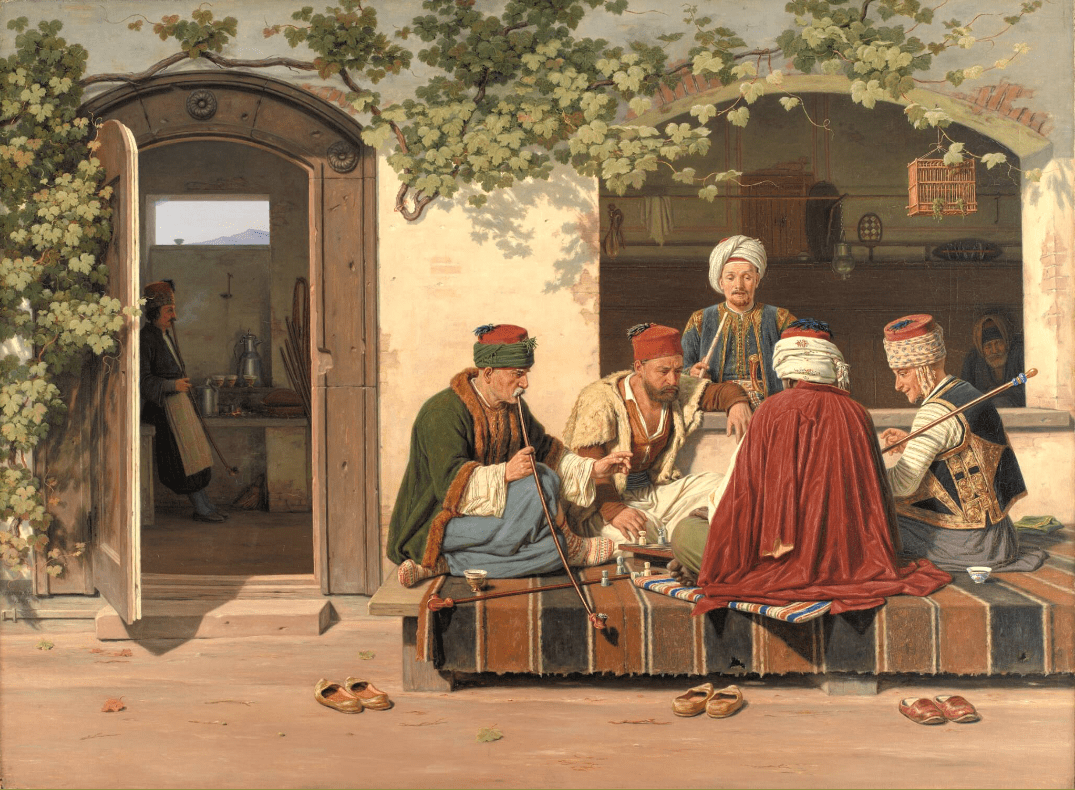
Picture: Rørbye, Martinus, “Orientals playing a game of chess outside a Turkish coffee house and barber shop.” Oil on canvas. 1845. The National Gallery of Denmark.
Bibliography
Akman, Ayhan. 2004. “Modernist Nationalism: Statism and National Identity in Turkey.” Nationalities Papers 32 (1): 23–51. https://doi.org/10.1080/0090599042000186214.
Azarian, Reza. 2011. “Nationalism in Turkey: Response to a Historical Necessity.” International Journal of Humanities and Social Science 1 (12).
Beckingham, Charles Fraser. 1957. “Islam and Turkish Nationalism in Cyprus.” Die Welt Des Islams 5 (1/2):65/https://doi.org/10.2307/1570254.
Colak, Yílmaz. 2008. “Nationalism and the State in Turkey: Drawing the Boundaries of ‘Turkish Culture’ in
the 1930s.” Studies in Ethnicity and Nationalism 3 (1): 2–20. https://doi.org/10.1111/j.1754-
9469.2003.tb00034.x.
Kadioğlu, Ayşe. 1996. “The Paradox of Turkish Nationalism and the Construction of Official Identity.” Middle
Eastern Studies 32 (2): 177–93. https://doi.org/10.1080/00263209608701110.
Ronald Grigor Suny. 2015. “They Can Live in the Desert but Nowhere Else” a History of the Armenian
Genocide. Princeton; Oxford Princeton University Press.
 Identity Hunters
One reply on “A Hat Revolution: The Fez and Turkish Nationalism”
[…] by the latter Ottoman Empire, instead of the Western style brimmed hats. You can find out more from here and […]
LikeLike