
By Zayd Riaz
“Martyrdom is a divine gift to the chosen ones. The magnificence of this lofty position is proportional to the grandeur of the sacrosanct self-sacrifice which draws the martyr to the field of resistance and nourishes him with the sweetness of martyrdom.”
Ayatollah Khomeini[1]
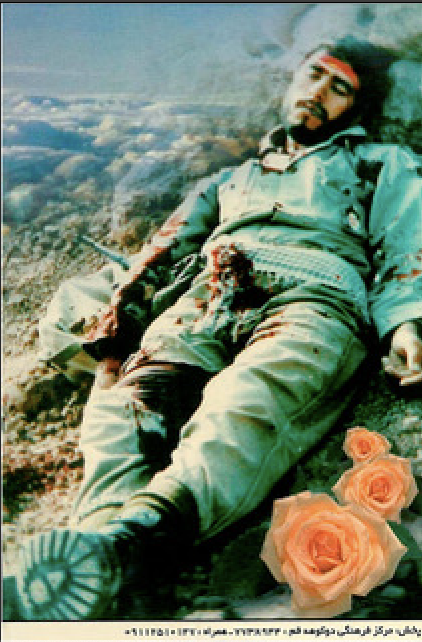
It was Khomeini who first linked the idea of Islamic Jihad and martyrdom with nationalistic politics,[2] reshaping the very meaning of what Jihad symbolises. For Muslims, martyrdom symbolises the sacrifice of your life as a testament of devotion to Allah. However, the Iranian nationalistic discourse re-framed and re-integrated the action of self-sacrifice for the cause of the Iranian Republic. Thus, as a by-product, the Shias within Iran, developed their own distinctive national identity. This new nationalistic formation of martyrdom created a double image, dying for Iran meant dying for God. Khomeini’s re-formulation of martyrdom gave him the ability to establish a paramilitary organisation, the Basij, for whom martyrdom represented the ultimate objective.[3]The Basijis, which means volunteers for the front, were provided with a red headband inscribed with a motto such as ‘Ya Saar Allah’ (Oh! The blood of Allah), which is conventionally associated with Hussein’s title. The headbands symbolised the readiness of their heads, akin to Hussein’s, for sacrifices to establish the “hokumat-e Allah” (the dominion of Allah).[4] Khomeini asserted that the Iranians would achieve victory in the conflict solely through a profound devotion to martyrdom. The contemporary narrative supplanted the conventional religious narratives wherein martyrdom was intricately linked to concepts of greater good or communal advantage for the “Muslim Ummah”. The contemporary narrative of martyrdom reinterprets old concepts in modern politics, positing that the realisation of the “greater good” is contingent upon national sovereignty and independence.
The image of heroic self-sacrifice is a powerful allure to individuals. Figures of heroes and martyrs serve not only as objects of ritual worship but also as conduits of transcendence, as they are frequently seen as exemplars of exceptional virtues and commendable moral values.[5] The desire to attain such moral virtue is what humanity strives for; the idea of becoming better and transcending the weakness of your mortal body has been entrenched within mythological literature for millennia. However, as René Girard’s philosophy of mimetic desire posits, humans don’t know what to desire, they have to be shown, they have to be directed, and then the laws of mimesis essentially take over.[6] Ayatollah Khomeini created a nationalistic discourse that built off the religious myths and stories of martyrdom and re-formulated it with nationalistic meaning. He imbued the Shia observance of Ashura, which commemorates the martyrdom of Hussein, as a nationalistic ideal to strive for.[7] Hussein’s sacrifice formed the template for the Iranian people to emulate. The heroic image of Hussein provided an identity framework which had self-sacrifice and martyrdom at the heart of it. Heroic actions of courage were used as symbols of moral virtue, one that must be followed. Heroes are used to galvanise a specific course of action directed at a particular object, with a specific method to follow. The acts of Mohammad Hossein Fahmideh, a 13-year-old boy, who, with grenades strapped across his body, stopped an Iraqi tank from advancing, exploded himself along with the tank.[8] His actions were deified, his actions formed as an idol for the Iranian youth to aspire to. The portrait of Hussein Fahmideh was disseminated nationwide and was included on Iran’s currency notes, his story and character were provided as templates for the Iranian youth to aspire to. Fahmideh was the model and the embodiment of the Iranian spirit. Welfare and Social Security Minister Sadeq Mahsouli, a former Revolutionary Guard commander, said last month that “children should be educated in such a way that when they reach the age of 13, they will be able to imitate Hossein Fahmideh”.[9] His actions were devoted and re-framed within the nationalistic martyrdom discourse, one to be emulated. The boy’s body was crucial to the Iranian identity. His death was a real-world example that gave extra backing and prestige to the martyrdom of Hussein, a real-world example for everyone to follow. If a 13-year-old boy can do it, so can you. The concept of martyrdom imbued the Iranian national identity with a sense of prestige and injected it with a warrior ethos that went back to the Golden Age of Islam. This example showcases how powerful religious myths, mixed with nationalistic discourse can create novel and unique methods of devotion to the nation.
Bibliography:
- Fomina, Victoria. “Between Heroism and Sainthood: New Martyr Evgenii Rodionov as a Moral Model in Contemporary Russia.” History and Anthropology 29, no. 1 (September 18, 2017): 101–20. https://doi.org/10.1080/02757206.2017.1375487.
- Girard, René. René Girard All Desire Is a Desire for Being-Anglais. Penguin Classics, 2023.
- Hossein Aryan. “How Schoolchildren Are Brainwashed in Iran.” RadioFreeEurope/RadioLiberty. Radio Free Europe / Radio Liberty, May 27, 2010. https://www.rferl.org/a/Commentary_How_Schoolchildren_Are_Brainwashed_In_Iran/2054304.html.
- Khamenei, Ayatollah. “Martyrdom Is a Divine Gift to the Chosen Ones: Ayatollah Khamenei.” Khamenei.ir, September 22, 2017. https://english.khamenei.ir/news/5170/Martyrdom-is-a-divine-gift-to-the-chosen-ones-Ayatollah-Khamenei.
- Overton, Iain. “The Price of Paradise Extract: Iain Overton on the Origins of the Suicide Bomber | British GQ.” British GQ, April 13, 2019. https://www.gq-magazine.co.uk/article/the-price-of-paradise-iain-overton-extract.
- Partow, Negar. “Martyrdom and Legacy of Blood.” Contemporary Review of the Middle East 1, no. 2 (June 2014): 165–88. https://doi.org/10.1177/2347798914532729.
[1] Ayatollah Khomeni, “Martyrdom Is a Divine Gift to the Chosen Ones: Ayatollah Khamenei,” Khamenei.ir, September 22, 2017, https://english.khamenei.ir/news/5170/Martyrdom-is-a-divine-gift-to-the-chosen-ones-Ayatollah-Khamenei.
[2] Negar Partow, “Martyrdom and Legacy of Blood,” Contemporary Review of the Middle East 1, no. 2 (June 2014): 165–88, https://doi.org/10.1177/2347798914532729.
[3] Ibid page 172
[4] Ibid page 173
[5] Victoria Fomina, “Between Heroism and Sainthood: New Martyr Evgenii Rodionov as a Moral Model in Contemporary Russia,” History and Anthropology 29, no. 1 (September 18, 2017): 101–20, https://doi.org/10.1080/02757206.2017.1375487.
[6] René Girard, René Girard All Desire Is a Desire for Being-Anglais (Penguin Classics, 2023).
[7] Negar Partow, “Martyrdom and Legacy of Blood,” Contemporary Review of the Middle East 1, no. 2 (June 2014): 165–88, https://doi.org/10.1177/2347798914532729.
[8] Iain Overton, “The Price of Paradise Extract: Iain Overton on the Origins of the Suicide Bomber | British GQ,” British GQ, April 13, 2019, https://www.gq-magazine.co.uk/article/the-price-of-paradise-iain-overton-extract.
[9] Hossein Aryan, “How Schoolchildren Are Brainwashed in Iran,” RadioFreeEurope/RadioLiberty (Radio Free Europe / Radio Liberty, May 27, 2010), https://www.rferl.org/a/Commentary_How_Schoolchildren_Are_Brainwashed_In_Iran/2054304.html.
 Identity Hunters