
The Author has requested to remain anonymous.
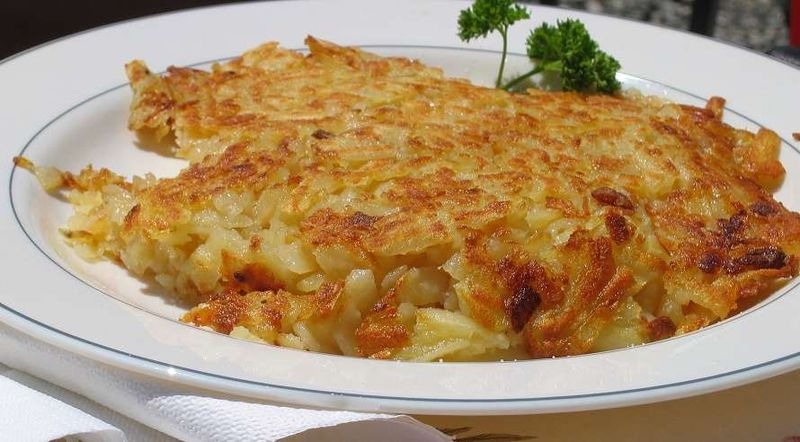
Roestis are a dish made from grated potatoes that are fried in a pan and often served as a pancake. The dish originates from the Swiss-German cantons Bern, Fribourg or Zurich, depending on the version, and was traditionally eaten for breakfast by farmers and peasants. Roestigraben means ‘roesti gap’, it refers to a cultural difference between French-speaking and German-speaking Switzerland and is mainly used to explain voting results.
The Roestigraben is a nationalist discourse produced by the concept of birth-culture, according to which being born into a certain culture define a person’s identity and is linked to their behaviour (Michelsen et al., 2023). According to this logic, being born into a Swiss German culture determines your identity as a lover of roesti, but not only that: it also determines how you vote. This discourse is based on the principle of immanence: the fact that a certain behaviour comes from within (Orellana et al. 2019). It therefore assumes that people do not choose their behaviour and that voting decisions are an expression of behaviour that comes directly from a person’s blood, genes and essence.
Swiss nationalism of the 19/20th centuries is often defined as civic, based on the idea of a Willensnation , however this can be misleading (Eugster, 2011). Olivier Zimmer argues that from the late 18th century to WWII, it combined voluntarism with an organic sense of nationhood : a Willensnation yet also a true Wesengemeinschaft (Zimmer, 2003). He challenges the civic vs. ethnic divide, suggesting forms of nationalism can develop in fusion, not just in parallel. In the 19th century, dominant ethnolinguistic nationalism in Europe challenged the authenticity of Switzerland’s national identity, which couldn’t rely on shared language or ancestry. The civic model (federalism, institutions, values) did not have the resources to respond to this challenge, giving rise to an ‘organic’ (rather than ethnic) nationalism, which blended with civic nationalism and expressed itself through a vocabulary evoking organic growth, even though it remained shaped by deterministic forces. Similarly, in the 1930s, Völkisch nationalism spread with National Socialism but remained marginal in Switzerland, where the ‘organic’ model drew on symbols like the Alps rather than race or bloodline. An essential conclusion can therefore be drawn: during this period, a society such as Switzerland, which cannot be defined strictly in ethnic terms, nevertheless succeeded in developing definitions of national identity that were essentialist and exclusive (Zimmer, 2003).
In 1914, media voiced concern over national unity as French- and German-speaking Swiss supported opposing sides in the war—a divide later linked to the Röstigraben (Brühwiler, 2016). The term itself emerged in the 1970s, alongside growing recognition of French-speaking Switzerland as a distinct region (Zierhofer, 2005). German-speaking dominance in referendums has since fueled tensions and academics like Donald Ipperciel have argued that the Röstigraben reflects a divide in spheres of communication rather than a genuine cultural or ethnic conflict (Ipperciel, 2007). Other researchers also note that this divide has gradually faded since the 2000s (Oresko, 2008; Koseki, 2003).
However, this article doesn’t aim to prove or disprove the Röstigraben, but to show that it extends beyond the French-German divide, reflecting concerns over national unity and a shift towards defining Swiss identity increasingly in cultural, ethnic, or linguistic terms. Indeed, the Röstigraben debate concerns particularly foreigner-related referendums and openness to Europe.
In the 1960s–70s, anti-immigration movements grew, led by right-wing parties like Nationale Aktion. Post-WWII, workers from Italy, Spain and Portugal, followed later by the Muslim diaspora from the Balkans arrived as temporary labor, gaining settlement rights only later through family reunification policies. Since the 1990s, the Swiss People’s Party (SVP) has made immigration central to Swiss nationalism, peaking in influence during the 2015 refugee crisis. Between 2000 and 2021, 16 referendums addressed issues related to foreigners (Porębski, 2021). Known for its well-funded, xenophobic and emotional campaigns, the SVP gained global attention in 2009 when Switzerland voted to ban minarets, a measure contrary to religious freedom (Hollifield, 2014). Swiss nationality criteria emphasise an ethnic and cultural view of identity, requiring applicants to prove assimilation of Swiss culture and their integration. Since 2018, third-generation foreigners can access simplified naturalisation, reinforcing the idea of ‘Swissness’ as inherited by blood. Though Swiss national identity as political and linked to values like neutrality and democracy persists, Beatrice Eugster’s survey shows most citizens and politicians define it culturally. This cultural pluralism mainly includes ‘native’ cultures, excluding those from immigration (Eugster, 2011).
This evolution of Swiss nationalism is directly reflected by the discourse of the Roestigraben. Based on the idea that culture is fixed and immutable, it defines a hierarchy between Swiss identities, determines who belongs to the nation and how the state distributes rights according to these different identities.
Bibliography :
- Porębski, A. M. 2021. “‘Foreigners’ in Modern Switzerland: Immigration Issues in Federal Popular Votes After 2000.” Journal of Modern Science 46(1): 269-286. https://doi.org/10.13166/jms/139661.
- Zierhofer, Wolfgang. 2005. “‘Röstigraben’: A Discourse on National Identity in Switzerland.” In B/Ordering Space, edited by Henk Van Houtum and Olivier Kramsch, 223–234. London: Routledge.
- Zimmer, Oliver. 2003. A Contested Nation: History, Memory and Nationalism in Switzerland, 1761-1891. Cambridge: Cambridge University Press.
- Bendix, Regina. 1992. National Sentiment in the Enactment and Discourse of Swiss Political Ritual.
- Hughes, Steven. 2012. The Limits of Cultural Nationalism: Italian Switzerland from a Risorgimento Perspective.
- Ipperciel, Donald. 2007. La Suisse: Un Cas d’Exception pour le Nationalisme?
- Zimmer, Oliver. 2004. “‘A Unique Fusion of the Natural and the Man-Made’: The Trajectory of Swiss Nationalism, 1933-39.” Journal of Contemporary History 39(1): 5–24. http://www.jstor.org/stable/3180667.
- Brühwiler, Ingrid, and Matias Gardin. 2016. “Fabricating National Unity in Torn Contexts: World War I in the Multilingual Countries of Switzerland and Luxembourg.” In Small Nations and Colonial Peripheries in World War I, edited by Gearóid Barry, Enrico Dal Lago, and Róisín Healy, 140–156. Brill. http://www.jstor.org/stable/10.1163/j.ctv2gjwt87.13.
- Oresko, Robert C. J. M. M. d’A. 2008. “De l’Helvétie Romaine à la Suisse Romande: Une Résidence en Suisse: Le Résident de France à Genève et son Rôle Face aux Troubles Politiques de 1734 à 1768.” The English Historical Review 123(504): 1289–1294. https://doi.org/10.1093/ehr/cen257.
- Eugster, Beatrice, and Olivier Strijbis. 2011. “The Swiss: A Political Nation?” Swiss Political Science Review 17(3): 394–416. https://doi.org/10.1111/j.1662-6370.2011.02029.x.
- Head, R. C. 2006. “Review of A Contested Nation: History, Memory and Nationalism in Switzerland, 1761-1891, by Oliver Zimmer.” Central European History 39(1): 131–133. http://www.jstor.org/stable/20457098.
- Michelsen, N., De Orellana, P., & Costa Buranelli, F. (2023). The reactionary internationale: the rise of the new right and the reconstruction of international society. International Relations, 39(1), 3-29. https://doi.org/10.1177/00471178231186392
- de Orellana, P., & Michelsen, N. (2019). Reactionary Internationalism: the philosophy of the New Right. Review of International Studies, 45(5), 748-767. https://doi.org/10.1017/S0260210519000159
 Identity Hunters