
By Mathilde Balmary and Lena Colle-Tri
https://assets.lls.fr/pages/6990724/doc1.jpg
Introduction
In 2003 the Haitian President Aristide gave a public speech within which he asked for reparations from France and the United States, for colonial exploitation. However, just a year after this speech, a coup was organized in order to overthrow President Aristide and his “provocative” proposition. If you think that this seems quite too perfectly timed to be coincidental, you would be right as in 2022, the French Ambassador to Haiti at the time, Thierry Burkard confessed that it was France and the
US that organized this political restructuration.
Here we ask ourselves: What if this coup never occurred? What if Haiti continued to ask France for reparations? What if this created a wave of political awakening from all of France’s former colonies?
What if France were to pay reparations to all its former colonies?
How to quantify reparations?
Do we solely address material loss? If so, do we adjust it with interest and inflation? Do we account for human trauma, loss, and suffering, and How? Should we also tackle the economic underdevelopment that resulted from independence?
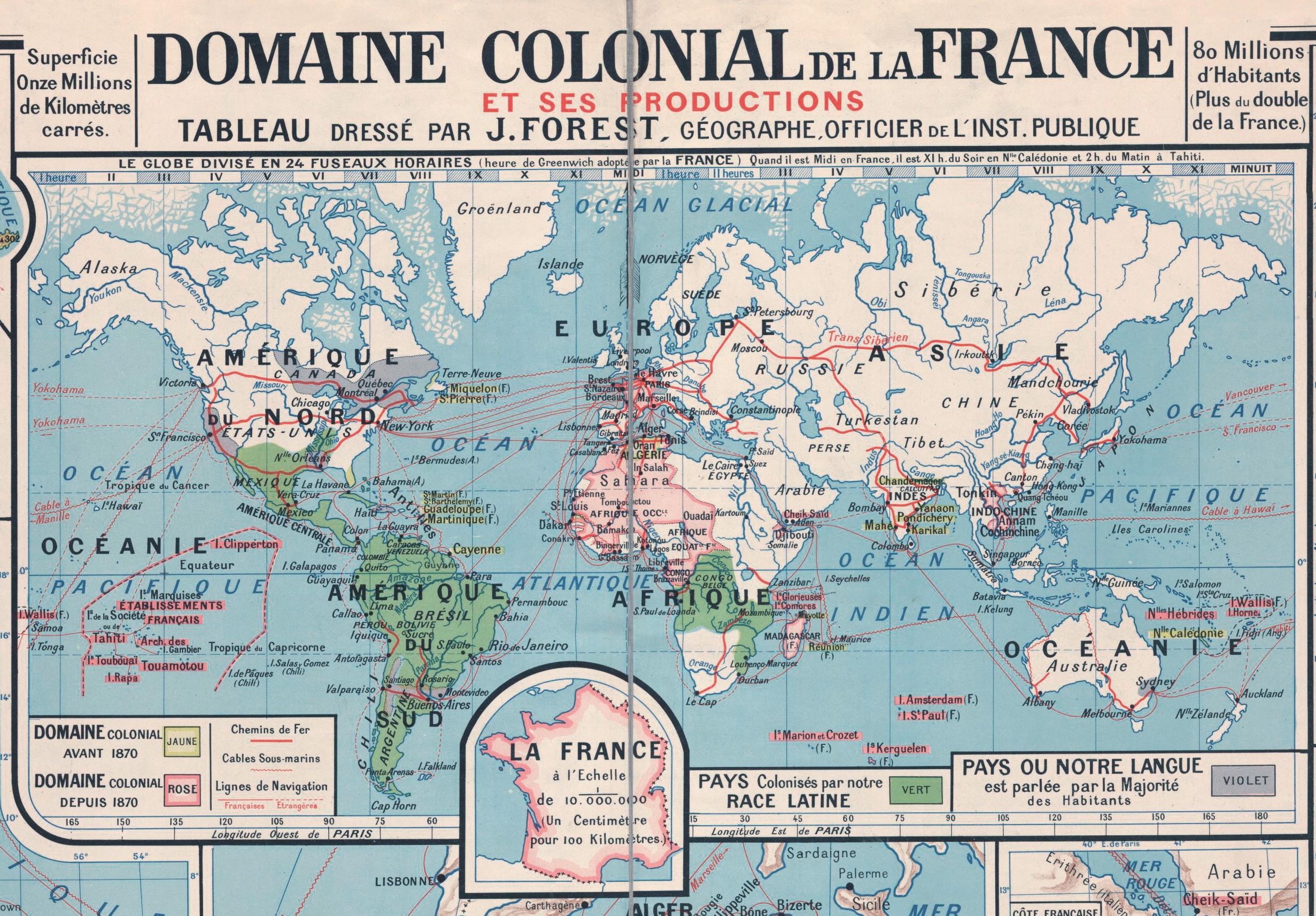
First, if focusing on the concrete economic loss, one should calculate the exact value of the resources extracted from the colonies. Adding this number to the total wages that should have been paid to the slaves and workers, we could come up with an amount. For example, France took large quantities of resources from Indochina and West Africa. If we link these quantities to a modern price, here it would be around $500 billion, and add to it the unpaid wages for the forced labour (estimated at around $1 trillion), we could arrive at a semi-realistic number for the concrete economic losses.
Second, if focusing on the traumatic reparation, one would need to calculate the compensations needed for those killed in colonial wars, massacres, and forced conscription in global conflicts. For example, in order to assign a financial value to these human losses, we could refer to the post WW2 reparations, where Germany paid $80 billion to Holocaust survivors. With the number of casualties, and human right breaches caused by French colonization, you can imagine how fast that number would rise up.
Finally, an amount should also be appointed for the huge opportunity loss suffered by these nations. They were left with agricultural-based economies which prevented them from benefiting from a possible industrial growth demonstrated by other independent states. If one compares the latter
states with similar GDP at the time (like South Korea for example) to the former colonies, projections reveal that some nations could have multiplied several times their current GDP.
Where does the money come from? Who pays?
Once one has established some kind of number, for the sake of this piece, let’s reach at around 30 trillion euros, combining direct financial loss, human suffering and opportunity loss, distributed to all former colonies, where would that money come from? France’s yearly GDP is around 2.7 trillion euros, meaning if France were to invest half that sum every year, it would take them around 25 years to fulfill those reparations. However, France’s current debt is approximately 110% of that GDP, losing more money than it is producing, said debt is also approximated to be around 3 trillion euros by itself. In practical terms it would be impossible for France to pay directly, but what if it had to? Money would obviously have to come at least in parts from the state’s pocket, taken directly from the government’s budget which would reflect heavily on taxpayers as well as cutting social and public funding. France could also create a “reparation fund”, similar to the aforementioned Holocaust reparations program. France, as part of the EU, is also a huge contributor of Foreign and
Development Aid internationally, these resources would most likely need reallocation. France also has the power to issue government bonds, in this case “colonial bonds” that could be a way to artificially generate the sufficient funds, but would of course highly destabilise the country’s national debt. Finally, it might be interesting for France to look for private companies, which have historically contributed to colonisation, to participate. The government could aim to either mandate their
participation by legally compelling them to or create some kind of willingful partnership. Companies such as Total have majorly inherited the resources produced by the former colonial titans “Compagnie Fraissinet”or the SFFC and still hold enormous investments in former colonies.
How should the payments be made?
Now, assuming that France could physically pay, comes the issue on how the trillions and trillions should be distributed. Should big checks be allocated to each country, in the form of a one time payment? In that case, how can one ensure, with many of those former colonies being autocracies, that the money doesn’t end in corrupt hands? Should they be repaid gradually in monthly or yearly installments? Here, that would make those countries financially dependent on France for an undetermined amount of time, although reducing the risks of financial mismanagement. Should it be made in the forms of investments directly into development infrastructures, healthcare, education, something similar to the Marshall Plan? This could be seen as a continuation of the French colonial
legacy through neocolonial practices, for example would France choose in which sectors the money should be allocated to? Should France offer those reparations in the form of foreign debt relief, which a lot of former colonies still struggle with? This one is probably the one preferred by scholars studying the question of reparations, but might be seens as unequal as not all former colonies possess significant French currency debt.
Can reparations make up for colonial legacy?
The colonial legacy of France extends way beyond financial and opportunity loss. The structures created during that time, political, socio-economic and racial still prevail and the dismantlement of these systems, cannot be achieved by a monetary reward. Reparations, although, extremely lucrative, would be seen as mostly symbolic, as recognising the impact of the colonial presence on the former country and a gesture towards pardon. The one-time investment would equally not
address foundational issues, such as artificial borders, artificial currency, the theft of artwork, the destruction of native languages and culture, the erasure of pre-colonial history, as well as the intergenerational trauma of systemic violence and hierarchy.
But are these admittedly superficial but substantial reparations better than no reparations at all? What kind of significant gesture could France propose other than this? One might assume that former colonial states would rather a formal apology followed by a big check rather than just a
symbolic gesture such as an official statement, but would this really make the past right? One thing reparations paid by France to their former colonies might achieve is the reduction of the neocolonial influence France still holds on its former colonies, such as with the France-Afrique
monetary policy, which ultimately continue to reinforce colonial structures and legacies. The reparations might readjust the financial and international power imbalance between the two nations and make them economically independent.
Should France pay?
Many nationalists argue that France should not be financially accountable for actions that today’s citizens did not commit. The nationalist perspective fears for French sovereignty and identity. Should today’s French citizens be accountable for something that happened during another political
time? Would it light the flame for other French territories, such as Corsica or overseas? And on top of that, claiming a historical double standard: Would former colonies also be responsible for historical wrongs of their own? The nationalist view insists that France has already paid this debt as
the nation holds deep economic ties with its former colonies, providing financial aids and opportunities.
Ironically, paying this reparation would mean that French taxpayers, including those of immigrant backgrounds, would be forced to pay for historical actions they did not participate in or worse, that their own families suffered from.
However, one can argue that morality does not have an expiration date. Should France pay even in the face of the economical and political consequences? Even with a fear of nationalist uprising and resentment?
Conclusion
France having to pay reparations to all its former colonies remains a highly hypothetical and not realistically feasible scenario but allows one to raise a range of possible challenges, being logistical or ethical. A number of nationalist narratives and discourses within countries stem from their
colonial past, this being from the side of former colonisers, such as France, through the national myth of a “civilising mission”, or the side of the former colony, such as Algeria, where the FLN uses its history as the party liberating the country from France as basis for legitimacy.
The subject of pardon and recognition of colonial horrors and long-standing legacies is an emotionally loaded and difficult topic for both parties involved. The road to a possible reconciliation is still hardious but with meaningful discussions, hopefully a consensus could be reached.
Bibliography
United Nations. (1945). Charter
United Nations. (2001). Responsibility of states for internationally wrongful acts.
United Nations. (2005) Basic Principles and Guidelines on the Right to a Remedy and Reparation
UNGA Resolution 1514 (1960)
UNGA Resolution 60/147 (2005)
 Identity Hunters