
By Eliot Tomlinson
Switzerland is often perceived as a maverick in international politics: a neutral, decentralised State that doesn’t quite fit the typical nation-state model. Its strong federalism, linguistic diversity, and cultural plurality raise questions about whether it can truly be understood as a nation at all. This blog explores how national symbols, particularly food, express both the tensions and unifying forces of Swiss nationalism.
1. Divided by Rösti…
Rösti incarnates the cultural divisions within Switzerland, mainly the division between the French and German-speaking populations. Rösti mostly consists of potatoes, an ingredient you can find everywhere in German culture. It incarnates a division between the Swiss-German and Swiss-French people, highlighting the German side’s rural background. This division is truly embedded in Swiss society with the concept of Röstigraben that separates the country along linguistic lines, reflecting the cultural change.[1] This Röstigrabenis also representative of Swiss politics, as the population often votes in referendums, and federal votes often divide the country along the Röstigraben, as in the 1999 vote on accession to the European Economic Area (EEA), with the French-speaking population more in favour of accession and the German-speaking partrejecting the referendum with only 50.3% of the votes.[2] But the Röstigraben is celebrated as a guarantor of protection of different cultures, rather than a symbol of division.

Swiss EEA membership 1992 referendum results along Röstigraben.[3]
2. … United in Fondue
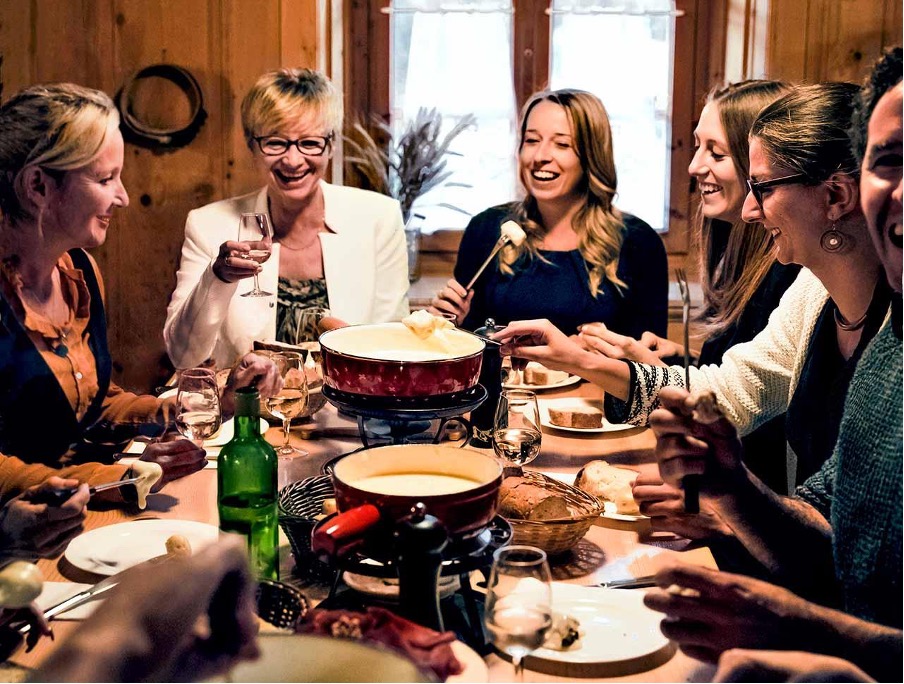
Fondue is a traditional national dish that is easy to cook and accessible to all – all one needs is a portable stove, a fondue pot, cheese, wine, garlic and seasoning. Fondue is when people get together over a shared meal, often with close friends and family, but also with colleagues and people just met. Fondue strengthens the Swiss identity, not only because it easily brings people together, but also because it ties in closely with other Swiss symbols such as cows, milk and cheese, mountains, snow and skiing, as it is often eaten during winter ski holidays. It connects Swiss cuisine to its geography, enhancing the feeling of a shared culture through a shared territory. This cultural unity of the country can be politicised to strengthen nationalist sentiments. For example, the Swiss Army is a conscript army, indiscriminately recruiting men from all corners of the country, reuniting people who do not necessarily share the same language or culture. The Cold War for example, was an era of uneasiness for Swiss conscripts as they were explicitly trained for the worst-case scenario, anticipating an invasion from the East. During this, the Army encouraged Swiss recruits to gather together and bond over fondues, further developing a spirit of camaraderie and shared culture. This ultimately reinforced a sense of national belonging, even though the country is a Confederation with a strict decentralisation of power and strong emphasis on small cantons. The fondue culture also reflects the great importance attached to regionalism, as there are many variations of fondue, depending on the locally produced cheese, be it Gruyère, Emmental, Vacherin Fribourgeois or Appenzeller. It also expresses its difference from the French fondue, with the particular use of Kirsch, a Swiss brandy, in the Swiss recipe. Hence, fondue truly unites the Swiss through the feeling of a shared unique culture.
Therefore, the Swiss people, although diverse, form a unity. Beyond the Röstigraben, which embodies the cultural and political divisions due to the language barrier through cuisine, the French-speaking and German-speaking Swiss share the same specialised word to describe the fondue pot, a caquelon, symbolising the unifying effect of fondue. Switzerland might not represent the vertical understanding of nationalism, as a fixed homogenising effect over identity, but incarnates a horizontal nationalism, as any Swiss person can overcome the normally perceived fundamental differences that divide nations to gather around a piece of melted cheese, temporarily erasing the Röstigraben that protects cherished difference and regionalities.
Bibliography:
- Evan, Andrews. Crossing the Röstigraben (Washington, DC: National Geographic, 2021)
- Kuenzi, Renat. A quarter-century of Switzerland’s special status in Europe (Bern: Swiss Info, 2017)
[1] Evan, Andrews. Crossing the Röstigraben (Washington, DC: National Geographic, 2021)
[2] Kuenzi, Renat. A quarter-century of Switzerland’s special status in Europe (Bern: Swiss Info, 2017)
 Identity Hunters