
By Layla Al Dabel
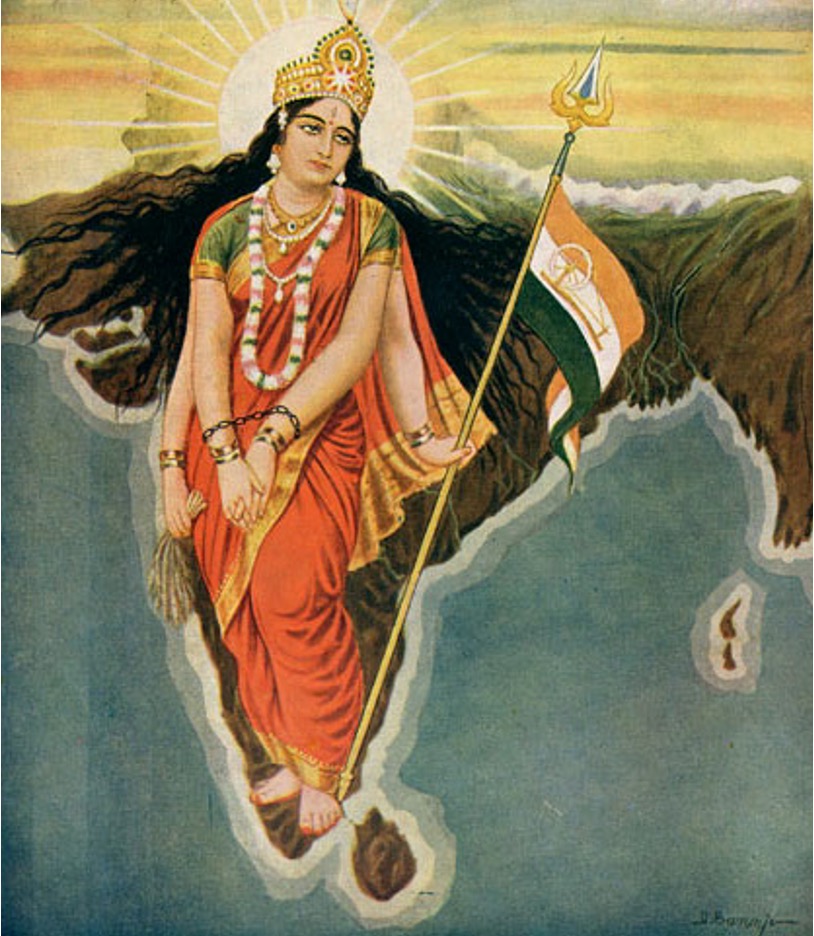
Draped in a saffron robe, holding the tricolor flag in one hand and symbols of Indian heritage in the other, Bharat Mata – Mother India – stands upon the map of undivided India. Her image, both divine and maternal, became the embodiment of the nation during India’s struggle for independence. In the 1940s, this powerful feminine symbol rallied millions to the cause of freedom, presenting the nation as a mother worthy of her children’s ultimate sacrifice (1).
The 1940s was a decisive phase of india’s independence movement against British colonial rule, marked by the non-violent resistance led my Mahatma Gandhi. The period witnessed unprecedented mobilization across Indian society – including women, whose participation Gandhi himself encouraged (1). Yet, beneath this apparent inclusivity lay a profound paradox – women were central to nationalist imagery but remained largely excluded from political power structures. This contradiction is epitomized by the symbol of Bharat Mata. In nationalist art, she appears in various forms – sometimes as a benevolent mother figure, at other times as a fierce goddess resisting colonial oppression. This feminine imagery performs crucial ideological work – by representing the nation as a woman, nationalists framed independence as a masculine duty to protect feminine honor. Colonial subjugation was portrayed as an assault on the nation’s sacred motherhood, necessitating the rise of sons in her defense.
Beyond symbolic representation, the movement constructed an ideal of the “new woman” – educated yet traditional, modern in appearance yet devoted to domestic duties (2). This duality is reflected in Gandhi’s vision of women’s participation. He encouraged women to join public protests like the Salt Satyagraha, recognizing their strategic value as protesters who might face less violent repression from British authorities (1). Yet he framed their partication in terms of traditionally feminine qualities: patience, sacrifice, and moral strength. “Woman is the embodiment of sacrifice and suffering, and her advent to public life should therefore result in purifying it,” Ghandi declared (3). His rhetoric celebrated women’s participation while simultaneously confining it within established gender norms. Women were welcomed as supporters, not leaders; as symbols of national virtue, not architects of the future state.
Despite these limitations, remarkable women emerged as prominent participants in the nationalist struggle. Sarojini Naidu became president of the Indian National Congress and later joined the Quit India Movement, facing imprisonment for her activism (4). Kamaladevi Chattopadhyay organized women’s participation in civil disobedience campaigns (4). Hansa Mehta contributed significantly to debates about women’s rights and later played a key role in drafting the Universal Declaration of Human Rights (5).
However, after independence in 1947, these women found themselves largely excluded from formal power structures. When the first Indian cabinet was formed, it included just one woman among fifteen ministers (6). In the Constituent Assembly that drafted India’s constitution, women constituted only 15 members out of 299 (7). Although the constitution guaranteed gender equality, the reality reflected the persistence of male political dominance. Even Jawaharlal Nehru, India’s first Prime Minister and a leader considered progressive on women’s issues, viewed women’s emancipation primarily as a byproduct of national development rather than a goal in itself (8). The women who had picketed, protested, and gone to prison during the nationalist struggle were now expected to return to primarily domestic roles, their political contributions honored symbolically but not rewarded with substantial political power.
This paradox reveals a fundamental tension within nationalist movements: while they mobilize all available groups in the quest for independence – including women – they frequently reinstate traditional gender hierarchies once independence is achieved. Nationalism often presents itself as a universal cause but operates through distinctly gendered frameworks that position men as active agents and women as symbolic bearers of national tradition. Understanding this pattern is crucial in recognizing how contemporary nationalist movements continue to instrumentalize women’s identities. Today, nationalists still position women as symbols of cultural authenticity while often resisting their full political empowerment. The gap between symbolic inclusion and substantive power remains a challenge for women’s political participation worldwide.
The image of Bharat Mata continues to resonate in Indian politics, a powerful reminder of how feminine imagery can mobilize nationalist sentiment. Yet, the limited political gains for women after independence demonstrate that symbolic centrality does not necessarily translate into tangible power. The mothers of the nation, it seems, were expected to nurture the new state – not to lead it.
Sources:
Cover Image (https://medium.com/@dineshpai_63008/bharat-mata-may-not-be-consolable-today-c182a6904cce)
- Thapar, S. (1993). Women as Activists; Women as Symbols: A Study of the Indian Nationalist Movement. Feminist Review, 44, pp.81-96. Available at: https://doi.org/10.2307/1395197 [Accessed 6 April 2025].
- Thapar-Bjorkert, S. (1997). The Domestic Sphere as a Political Site: A Study of Women in the Indian Nationalist Movement. Women’s Studies International Forum, 20(4), pp.493-504. Available at: https://doi.org/10.1016/S0277-5395(97)00038-1 [Accessed 6 April 2025].
- Gandhi, M.K. (n.d.). Woman. Voice of Truth. [online] Available at: https://www.mkgandhi.org/voiceoftruth/woman.php [Accessed 6 April 2025].
- Vajiram & Ravi (2025). Role of Women in Indian Freedom Struggle. [online] Available at: https://vajiramandravi.com/upsc-exam/role-of-women-in-indian-freedom-struggle/ [Accessed 6 April 2025].
- United Nations (n.d.). Women Who Shaped the Universal Declaration of Human Rights. [online] Available at: https://www.un.org/en/observances/human-rights-day/women-who-shaped-the-universal-declaration [Accessed 6 April 2025].
- National Library of Australia (n.d.). Newspaper Article. Trove. [online] Available at: https://trove.nla.gov.au/newspaper/article/58784828 [Accessed 6 April 2025].
- Bharti, R.K. and Kumar, R. (2024). The Role of Women in Making of Indian Constitution. International Journal of Education, Knowledge and Science (IJEKS), [online] Available at: https://ijeks.com/wp-content/uploads/2024/03/IJEKS-3-02-007.pdf [Accessed 6 April 2025].
- Centre for Women’s Development Studies (CWDS) (2024). Women and Indian Nationalism. [online] Available at: https://www.cwds.ac.in/wp-content/uploads/2024/11/WomenandIndianNationalism.pdf[Accessed 6 April 2025].
 Identity Hunters