
By Aron Tisoczki
The British Museum’s ‘Enlightenment Gallery’ aims to introduce visitors to an experience reminiscent of an eighteenth-century museum, replicating an environment that visually and tangibly evokes the Georgian era. However, the museum’s eighteenth-century worldview establishes Britain as intellectually superior. The gallery not only seems to celebrate British expansionism as triumph of knowledge and progress, but also functions as a monument to British nationalist identity.
The Enlightenment Gallery
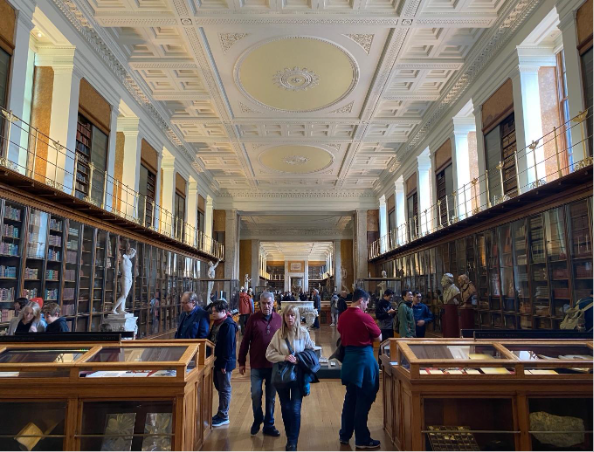
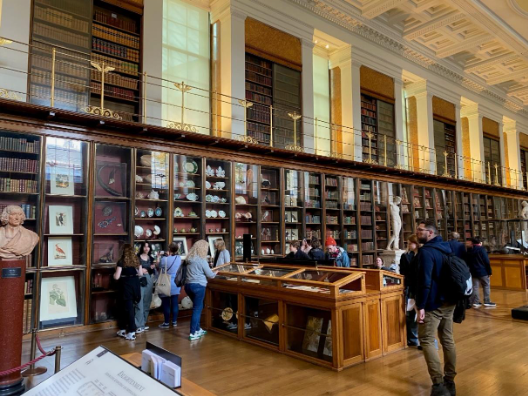
The gallery itself is designed in the style of a personal library, its walls lined with large antique bookshelves, filled with literature covering geography, history, anthropology, medicine, and more. It is organised according to seven overarching ‘themes’, containing twenty-four displays, which are designed to evoke “the experience of a museum visitor in the early years of the British Museum” (1). The space itself was once intended to hold the personal library of King George III, and later encompassed Sir Hans Sloane’s personal collection, which became the foundation of the British Museum (2). Unlike traditional exhibits, the Enlightenment Gallery encourages visitors to think independently. Not only are artefacts placed within broader themes than usual, but the number of descriptions is also reduced, which makes the artefacts contextualised more by their setting than by their accompanying texts (3).
The Enlightenment era is deeply tied to imperial domination and the installation of European sovereignty over the world (4). The very historical design of the gallery implicitly ties the history of knowledge and discovery to British national identity, reinforcing a nationalistic image of grandeur and claiming British intellectual and cultural dominance over the artifacts within it. The gallery casts Enlightenment ideas as an organising principle – a totalising system of knowledge that claims sovereignty over the non-European artifacts within it. It frames the period as one of scientific and cultural superiority, subtly aligning British imperial identity with the idea of progress. In doing so, it entirely omits the collection’s exploitative origins and the broader context of its acquisition.
A sanitisation of Empire
A striking element of the gallery and its approach is its absence of critical engagement with colonial violence or imperial expansion. Although the vast majority of artefacts originate from outside Britain, not much attention is paid to this fact. Contrary to the minor emphasis found on the gallery’s webpage (5), there is a distinct absence of focus on the aggressive and expansionist acquisition of the objects within the gallery. Instead, the gallery seems to unquestioningly propagate a nationalist narrative, portraying Britain’s imperial past in a neutral or even positive light. Aboriginal artefacts for example are placed in the quite politely named “Empire and Collecting” display section.
By framing its collection within these themes, the gallery actively omits the more uncomfortable aspects of Britain’s past. The historical environment celebrates Britain’s role as a global collector of knowledge while the minimal curation neglects more uncomfortable aspects of its past. The background of Sir Hans Sloane as a slave owner for example, is barely acknowledged—even though this has contributed to controversy (6). The additional resources available to visitors appear equally partial. While the quite extensive study guide mentions various minutiae, terms like ‘imperialism, ‘colonialism’ or ‘slavery’ are absent (7). This sanitised portrayal softens Britain’s historical role into one of benign curiosity rather than aggressive expansion.
Curating identity
What the Enlightenment Gallery exhibits best of all is its function as a monument to Britain’s imperial legacy and nationalist identity. To no surprise, the possession of some of the artefacts contained within the gallery has been called into question (8). Public history is often shaped to serve nationalist narratives, using cultural institutions to reinforce particular visions of national identity. Public history actively constructs and reinforces national identity in the present – national museums, as institutions of culture, visualise the nation and its identity through their architecture and their selection of narratives (9). They create a ‘national story’ that often emphasises moments of intellectual greatness while minimising histories of wrongdoing. The Enlightenment Gallery is no exception.
The British Museum has a close connection to British national identity, curating its exhibits in ways that celebrate Britain’s past achievements. By presenting history through a lens of British discovery and innovation, the gallery contributes to an enduring myth of exceptionalism and cultural entitlement. The Enlightenment Gallery serves not simply as an educational space but as a nationalist project—one that reinforces Britain’s self-perception as a benevolent global power and steward of world heritage. Visitors are ultimately left with a romanticised understanding of Britain’s role in world history, one that elevates British intellectual achievement and stands as a monument to British nationalism.
References
- British Museum, Accessing Enlightenment: Study Guide (London: 2003).
- Jeremy Coote, “Gallery Reviews: Enlightenment: Discovering the World in the Eighteenth Century, at the British Museum”, Journal of Museum Ethnography 19 (2007), 135.
- Coote, “Gallery Reviews”, 138.
- Ann Laura Stoler, “Reason Aside: Reflections on Enlightenment and Empire.” In The Oxford Handbook of Postcolonial Studies, by Graham Huggan (Oxford: Oxford University Press, 2013), 39-40.
- British Museum, Enlightenment, accessed 30 March, 2025.
- Lanre Bakare, “British Museum boss defends moving bust of slave-owning founder”, The Guardian, 25 August 2020.
- British Museum, Study Guide.
- Nick Miller, “The gripping story of the Gweagal Shield”, The Sydney Morning Herald, 11 May 2019.
- Gabriella Elgenius, “National museums as national symbols: A survey of strategic nation-building and identity politics; nations as symbolic regimes” in National Museums and Nation-building in Europe 1750-2010, by Peter Aronsson and Gabriella Elgenius (London: Routledge, 2014), 148.
Bibliography
Bakare, Lanre. 2020. “British Museum boss defends moving bust of slave-owning founder.” The Guardian, August 25. https://www.theguardian.com/culture/2020/aug/25/british-museum-boss-defends-moving-bust-of-slave-owning-founder.
British Museum. 2003. Accessing Enlightenment: Study Guide. London.
British Museum. Enlightenment. Accessed March 30, 2025. https://www.britishmuseum.org/collection/galleries/enlightenment.
Coote, Jeremy. 2007. “Gallery Reviews: Enlightenment: Discovering the World in the Eighteenth Century, at the British Museum.” Journal of Museum Ethnography 19: 135-141.
Elgenius, Gabriella. 2014. “National museums as national symbols: A survey of strategic nation-building and identity politics; nations as symbolic regimes.” In National Museums and Nation-building in Europe 1750-2010, by Peter Aronsson and Gabriella Elgenius, 145-166. London: Routledge.
Miller, Nick. 2019. “The gripping story of the Gweagal Shield.” The Sydney Morning Herald, May 11. https://www.smh.com.au/world/europe/the-gripping-story-of-the-gweagal-shield-20190511-p51mbe.html.
Stoler, Ann Laura. 2013. “Reason Aside: Reflections on Enlightenment and Empire.” In The Oxford Handbook of Postcolonial Studies, by Graham Huggan, 39-66. Oxford: Oxford University Press.
 Identity Hunters