
By Angelika Etherington-Smith
Kazakhstan occupies a complex and often uneasy position in modern geopolitics, shaped above all by its deep, colonial entanglement with Russia. Growing up there, one is acutely aware not of a balanced position between global powers, but of Russia’s overwhelming cultural, political, and linguistic influence—a legacy of both Tsarist and Soviet imperialism that nearly erased Kazakh identity from public life. From language and education to architecture and media, the Russian imprint was—and in many ways remains—so dominant that it often left little space for expressions of indigenous Kazakh culture.
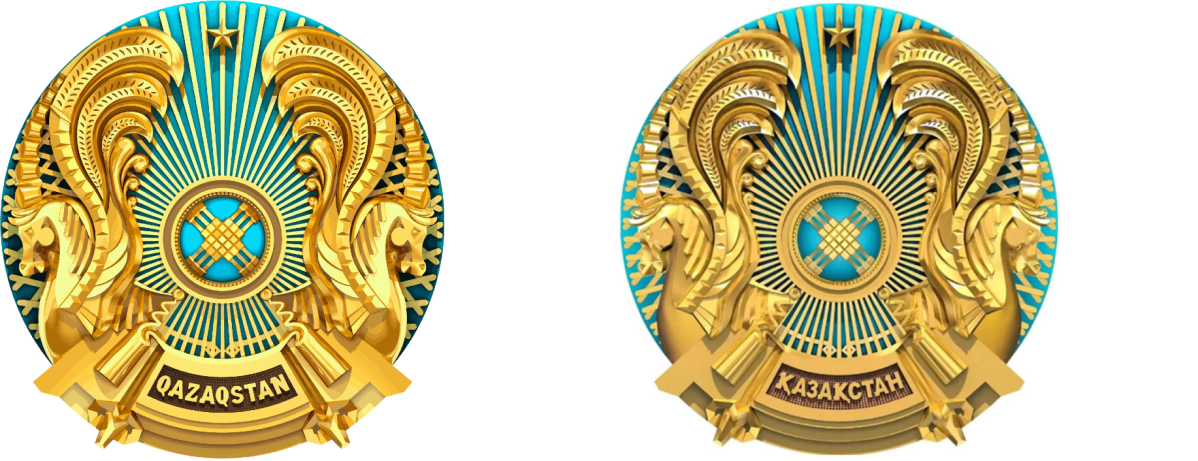
Finally gaining sovereignty in 1991, Kazakhstan went through a lot of key changes, including changing its capital city from Almaty to Astana and establishing its own national symbols including a new flag, hymn, and emblem. In 2018 a new change occurred, latinising the script of the name of the state, with the emblem now reading “QAZAQSTAN” instead of the previous “ҚA3AҚCTAH” as pictured above. This change was one of the last acts of President Nasarbaev’s tenure before he was forced to resign in a wave of protest following his nearly 3-decade-long post. Kassym-Jomart Tokayev took his place, implementing more reforms and changes to legislation that Latinised the Kazakh language in day-to-day instances and engaging in other policies promoting the language in the state(1). This has led to an outcry of Russian officials claiming the Russian language is being marginalised and mistreated(2).
Similar calls have been happening since 2004 when a leader from LAD, a “Republican Slavic Association”(3) appealed against the increased use of the Kazakh language in society, claiming that “Kazakh … cannot serve as a language of modern politics, science and education [as it] never was the language of ‘civilization’ but just the language of nomad poetry”(4). Bissenova argues that the language debates accurately reflect the cultural and ethnic tensions between the Russian and Kazakh populations in the state(5). She makes the case for an ethno-nationalist approach to refining Kazakh identity through language, arguing that with demographic changes “ethnic Kazakhs will determine the future of Kazakhstan”(6).
The language difference isn’t the only symbolic element in the Emblem that brings questions to modern Kazakh identity. While having many elements linking back to the nomadic past – like horses and shanyrak – both versions of the emblem have a 5-pointed star at the top. The official state website explains that the star as a link to the “ancient aspiration of people [towards the] light of truth”. It also claims it “reflects the dream of people to build a state open to all countries of the world for cooperation and partnership” (7). While this romantic explanation seemingly links to the state’s nomadic legacy and political openness, the use of the five-pointed star across Soviet iconography – and its continued use in Kazakh military insignia complicates the reading(8).
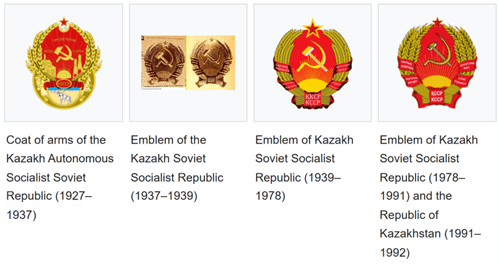
Red and yellow stars were common symbols of the Soviet Union and spread to many Soviet republics. The image above shows variations of the Kazakh emblem during it’s time in the USSR, with a 5-pointed star in the same location as one in the Soviet versions. The retention of a star in the same position suggests not a clean symbolic break with the Soviet past but a visual continuity of the Soviet colonial identity. This calls into question the extent to which Kazakhstan has fully reimagined itself post-independence. The sovereign identity argument is further undermined by the red star appearing in emblems of the Kazakh Air Assault, Ground, Naval, Armed forces and on the flag of the Ministry of Defence(9). Considering the blue and yellow colour scheme of Kazakh emblems, the persistence of a stridently Soviet symbol within its most state-assertive institutions – the military – undermines efforts to present a fully decolonised national aesthetic. By maintaining symbols that look and feel Russian, the state provides a sense of continuity that appeases Russian-speaking populations – and the Russian state – wary of full cultural detachment, failing Kazakhstan’s post-colonial identity project.
The identity of the Kazakh nation is uncertain despite strengthening ethno-nationalist sentiment present amongst a large proportion of the population. While Latinising an alphabet that’s been Cyrillic since 1940 (10) seems like a firm ideological and political step away from the coloniser, the continued presence of coloniser symbolism in the post-colonial state – especially embedded in its most authoritative symbols/branches – complicates the sustainable consolidation of a truly ideologically Kazakh nationalism. What emerges instead is a hybrid identity, pulled apart by a desire for cultural reclamation and the lingering shadows of the Russian and Soviet empires.
References
1: Азаттық радиосы. “Тоқаев Ұлттық құрылтайда елтаңба өзгеретінін жариялап, “қазақ тілін ешкімді мәжбүрлемей дамыту” жайлы айтты.” Азаттық радиосы, 15 Mar. 2024, www.azattyq.org/a/32863052.html.
2:Moscow Times. “Moscow’s Consul in Kazakhstan Dismissed After Criticizing Decline of Russian Language Teaching – The Moscow Times.” The Moscow Times, 28 Aug. 2023, www.themoscowtimes.com/2023/08/28/moscows-consul-in-kazakhstan-dismissed-after-criticizing-decline-of-russian-language-teaching-a82272.
3:Валентина, Ключарева. “Республиканское славянское движение “ЛАД” в Казахстане: история создания и современная деательность.” Omsk laboratory of Archeology, Ethnography and Museology, 2016, pp. 1041–45, paeas.ru/x/ru/2023/2023_1041-1045.pdf.
4: Bissenova, Alima. “LANGUAGE DEBATE IN KAZAKHSTAN REFLECTS RUSSIAN-KAZAKH TENSIONS.” CACI Analyst, 2004, www.cacianalyst.org/publications/analytical-articles/item/8894-analytical.
5: Ibid
6: Ibid
7: “National Emblem of Kazakhstan — Official website of the President of the Republic of Kazakhstan.” Akorda.kz, www.akorda.kz/en/state_symbols/kazakhstan_emblem. Accessed 26 Mar. 2025.
8: Wikipedia contributors. “Emblem of Kazakhstan.” Wikipedia, The Free Encyclopedia. Wikipedia, The Free Encyclopedia, 25 Dec. 2024. Web. 26 Mar. 2025.
9: Appendix 1-5
10: RadioFreeEurope RadioLiberty. “Kazakh President Orders Shift Away From Cyrillic Alphabet.” RadioFreeEurope/RadioLiberty, 12 Apr. 2017, www.rferl.org/a/kazakh-president-orders-shift-from-cyrillic/28425590.html.
Bibliography
- Азаттық радиосы. “Тоқаев Ұлттық құрылтайда елтаңба өзгеретінін жариялап, “қазақ тілін ешкімді мәжбүрлемей дамыту” жайлы айтты.” Азаттық радиосы, 15 Mar. 2024, www.azattyq.org/a/32863052.html.
- Валентина, Ключарева. “Республиканское славянское движение “ЛАД” в Казахстане: история создания и современная деательность.” Omsk laboratory of Archeology, Ethnography and Museology, 2016, pp. 1041–45, paeas.ru/x/ru/2023/2023_1041-1045.pdf.
- Bissenova, Alima. “LANGUAGE DEBATE IN KAZAKHSTAN REFLECTS RUSSIAN-KAZAKH TENSIONS.” CACI Analyst, 2004, www.cacianalyst.org/publications/analytical-articles/item/8894-analytical.
- Moscow Times. “Moscow’s Consul in Kazakhstan Dismissed After Criticizing Decline of Russian Language Teaching – The Moscow Times.” The Moscow Times, 28 Aug. 2023, www.themoscowtimes.com/2023/08/28/moscows-consul-in-kazakhstan-dismissed-after-criticizing-decline-of-russian-language-teaching-a82272.
- “National Emblem of Kazakhstan — Official website of the President of the Republic of Kazakhstan.” Akorda.kz, www.akorda.kz/en/state_symbols/kazakhstan_emblem. Accessed 26 Mar. 2025.
- RadioFreeEurope RadioLiberty. “Kazakh President Orders Shift Away From Cyrillic Alphabet.” RadioFreeEurope/RadioLiberty, 12 Apr. 2017, www.rferl.org/a/kazakh-president-orders-shift-from-cyrillic/28425590.html.
- Wikipedia contributors. “Emblem of Kazakhstan.” Wikipedia, The Free Encyclopedia. Wikipedia, The Free Encyclopedia, 25 Dec. 2024. Web. 26 Mar. 2025.
Appendix


 Identity Hunters


