
By Mingchen Zhao
With the introduction of the concept of a national flag after the Opium War (1840), China’s first national flag, the ‘Yellow Dragon Flag’, was developed by the Qing Dynasty in 1862, soon followed by several others. This article will examine Chinese flags and discuss how they reflect nationalism.

Yellow Dragon Flag: The Emperor Shall Rule for Ten Thousand Generations
The Manchurians, as a minority nation, did not like nationalism, so the Qing’s flag emphasized the pride of the Manchurians in their aristocratic status, not the national identity of all Chinese. It was a typical product of the monarchical and authoritarian era and highlighted the majesty of monarchy and empire rather than nationalism. Using royal symbols and colors and nearly copying the imperial standard flag (figure above), this flag was irrelevant to the public. Moreover, the Yellow Dragon Flag, whose patterns and artistic style were a replica of the ‘Eight Banners’ (figure above, the Manchurian noble groups), was of an aristocratic nature.
The Han Chinese were the majority nation of the Qing Dynasty, but their symbols were not used in the flag, instead, they were politically oppressed by the Manchurians. (Sun, 1897). As embodied in the 1908 Constitution, ‘The Emperor shall rule for ten thousand generations’, not the people.

Five-colored Flag: ‘Han National Independence’ to ‘Five Races Under One Union’
In the early years of the Republic of China, two flags successively assumed the role of the national flag. During the 1911 revolution, Sun Yat-sen and the revolutionary army used the ‘Iron-Blood 18-Star Banner’ as the symbol of the independent Han provinces. This flag signified the overthrow of Manchu rule with a revolution of iron and blood (figure above). This flag represented the ‘Nationalism’ of the early Three Principles of the People, i.e. the fight for the independence of the Han Chinese (Tongmenghui, 1906). This change emphasized the dominant position of the Han nation and the character of a racial revolution, with the expulsion of the Manchus and the imminent establishment of a Han nation-state.
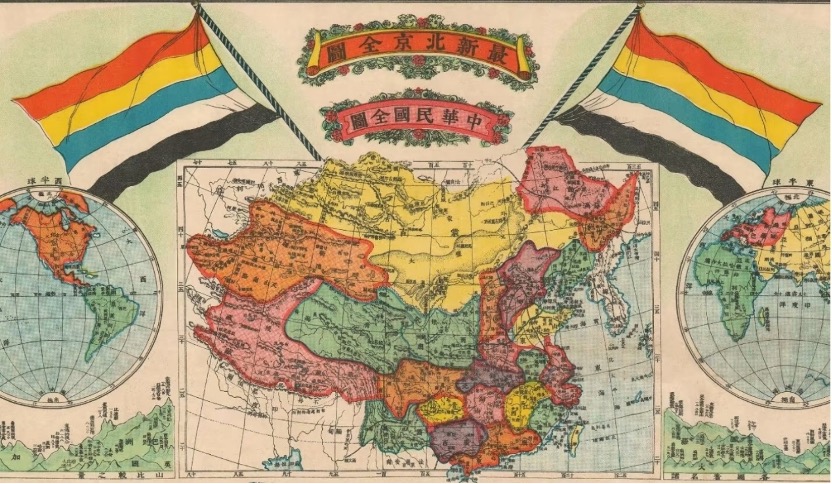
When the revolution achieved a stage of victory, Sun Yat-sen adopted the ‘Five-colored Flag’ and used it in the ceremony of his inauguration as Provisional President in 1912. Unlike the ‘18-star Banner’, the ‘Five-colored Flag’ emphasized the equal status of the five races: Han, Manchu, Mongol, Tibetan, and Hui. As Sun said in his inaugural proclamation, ‘The five races are united as one nation’ (Sun, 1912). This flag, symbolizing ‘Five Races Under One Union’, was used until the victory of the Northern Expedition (1928). This change in the flag embodied the transition of Sun’s nationalism. To govern a large country, Sun wished to construct a new Chinese nation by promoting domestic equality (Sun, 1912). In addition, there was a simultaneous change in Han national identity. With the Manchus eliminated, the goal of Nationalists became the maintenance of border stability, achieved by such a rhetoric of unity.

Blue Sky, White Sun, and a Wholly Red Earth: United Front of All Nation
Chinese flag (figure above) began to emphasize political alliance to achieve nationalist goals. In the First United Front (1924-1927), Sun Yat-sen added opposition to imperialism and warlords to his theory of nationalism (Gregor & Chang, 1982). Nationalists and communists joined together to establish the National Revolutionary Army (NRA) and hoped to reunite China through the Northern Expedition. Then the National Revolutionary Movement began, and this flag was used as a symbol of national unity and independence. Although the flag did not have any nationalist elements, its role in the National Revolutionary Movement and the Northern Expedition made it a symbol of nationalism in China in the 1920s.
During the Second United Front (1936-1945), the national flag became the symbol of China’s all-national resistance to invasion. NRA, the Red Army and other factions shared this flag. For example, the Communists abandoned the Red Flag in favour of national and military flags in line with the nationalists (figure above). Despite their political and ideological conflicts, they were united under the same flag with ‘All-National Resistance’ as their slogan. Just as Chiang Kai-shek said in his Lushan speech ‘Only with the lives of the whole nation can the country survive’ (Chiang, 1937).
In conclusion, the ‘Yellow Dragon Flag’ emphasized the dominance of the Emperor and the Manchurian aristocracy, while weakening nationalism. After the 1911 revolution, Han Chinese and nationalists adopted the ‘Five-Colored flag’ symbolizing national equality and the new Chinese nation. ‘Blue Sky, White Sun, and a Wholly Red Earth’, moreover, represented not only political cooperation but also national unity and resistance to invasion.
Reference
Chiang, K. (1937). Lushan speech.
Gregor, A. J., & Chang, M. H. (1982). Marxism, Sun Yat-sen, and the Concept of “Imperialism.” Pacific Affairs, 55(1), 54–79.
Great Qing. (1908). Principles of the Constitution.
Kuomintang. (1912). Manifesto of the 1st National Congress of the Kuomintang.
Sun, Y. (1897). China’s Present and Future – Revolutionary Party Calls on Britain to Maintain Neutrality in Good Faith.
Sun, Y. (1912). Declaration of Sun Wen, President of the Republic of China.
Tongmenghui of China. (1906). The Revolutionary Strategy of Tongmenghui of China.
 Identity Hunters