
By Sophiya Duale
Colonial souvenirs tell a tale of how conquest can be converted into cultural sophistication. Britain’s imperial ambitions weren’t satisfied with territorial conquest, they extended into the cultural realm, crafting national prestige through collections of foreign treasures. Displaying ‘exotic’ acquisitions served beyond decorating museums with new shiny objects. They became a performance of state power, materialising Britain’s political-cultural identity. Possession exhibited mastery over entire civilisations, granting the elite a theatre for demonstrating refined taste.
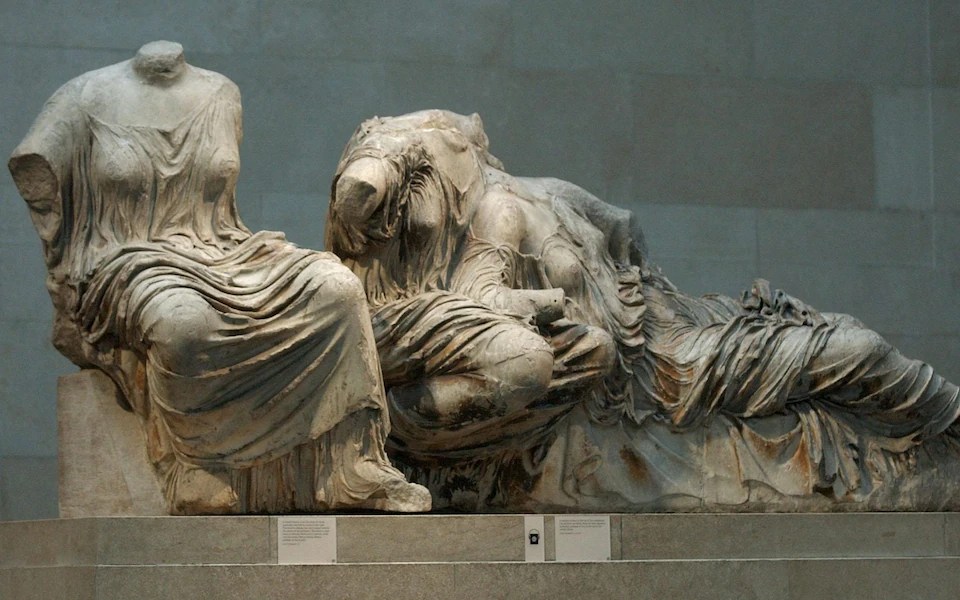
Recasting vessels of cultural memory as ‘works of art’ has subjugated sacred artifacts into aesthetic specimens for Western consumption (1). For the Edo people, the Benin Bronzes weren’t mere art, they were historical markers, as their removal left a vacuum in cultural records (2). When Greece’s Minister of Culture described the Parthenon Marbles as the ‘blood and soul of the Greek people’, they captured the living connection between past objects and present national identity (2). Each carved figure symbolised the shared memory, struggles and triumphs which shaped modern Greece. The Rosetta Stone’s role as the “icon of Egyptian identity” speaks to something equally profound (2). It represented Egypt’s
intellectual legacy in unlocking ancient hieroglyphs. This reveals a deeper form of imperial violence – converting living heritage into ornaments for Britain’s imperial trophy case.
Once displaced, artifacts suffer a double loss: their physical removal and then their interpretative capacity, producing an unequal cultural exchange where only one side has the power to speak. Distance therefore becomes both geographical and cultural. Modern museums don’t simply just house items, they shape how they are represented. When a spiritual vessel moves from a ceremonial space to a glass box in a museum corner, it loses something fundamental, being reborn under an institutional gaze. Once a living participant in Athenian religious life, the Parthenon Marbles are now instead a trophy of British classical artistry. This one-sided conversation sets the tone for logic regarding repatriation. British Museum defenders claim that time has severed Greece’s connection to its ancient artifacts, therefore paradoxically enabling their timeless right to hold them (3). Take former director Neil MacGregor’s revealing statement that ‘Questions of ownership depend on the thought that an object can only be in one place’ (2). Dismissing the significance of authentic cultural context positions Western appreciation over true native connection.
Resistance to repatriation has also been wrapped in concerns of indigenous preservation capabilities revealing a deeply paternalistic attitude echoing the ‘white man’s burden’ rhetoric. Positioning themselves as responsible guardians reproduces the same civilisational hierarchies which justified empire. Defenders of museum culture reach new heights of colonial arrogance: claiming Egyptians only valued their heritage after European ‘discovery’ of the Rosetta stone (2). They assert a privileged capacity for artistic appreciation, placing Western institutional knowledge above indigenous cultural understanding. This perpetuates the same regressive distinction between rational European races from the incompetent rest. Britain’s professed ‘love of antiquity’ similarly becomes a shield against Greek requests for return of Elgin marbles to Athens. This defence has found powerful backing in British legislation, transforming cultural appropriation into legally protected ‘stewardship’ (4).
Under the weight of contemporary ethical awareness, constructed narratives of legitimate ownership begin to crumble. British museum visitors openly question ‘Shouldn’t it be somewhere else?’ or describe it as representative of ‘the spoils of British Imperialism’ (5). Performative displays of multiculturalism struggle to distract the public from the inherent disconnect. Nothing quite says ‘we’ve evolved beyond colonialism’ like a carefully curated exhibition of things we’re still refusing to give back.
It’s important to remember, Britain’s only claim to these artifacts stems from the exploitative acts which secured their seizure. The hands which crafted the Benin Bronzes, weaved the Dhaka muslin and moulded the Ashanti gold regalia were the same hands physically and metaphorically bound by imperial violence. Ironically, a country once in control of a vast empire derives status not on what it created but what it forcibly took from those it subjugated. Robert Aldrich interestingly asks, ‘When the colonial flags were lowered, what was to become of museums that lost their very reason for being?’ (6).
Bibliography
Cover image: https://www.telegraph.co.uk/news/2019/01/01/uk-museums-task-staff-identifying-stolen-colonial-collections/
1 – Malick Ndiaye, El Hadji. “Musée, Colonisation, et Restitution.” African Arts 52, no. 3 (2019): 1–6. https://muse.jhu.edu/article/732054.
2 – Duthie, Emily. “The British Museum: An Imperial Museum in a Post-Imperial World.” Public History Review 18, no. 18 (December 31, 2011): 12–25. https://doi.org/10.5130/phrj.v18i0.1523.
3 – Barringer, Tim, and Tom Flynn. Colonialism and the Object. Routledge, 2012. https://doi.org/10.4324/9780203350683.
4 – CUNO, JAMES. Who Owns Antiquity? Princeton University Press, 2010. https://doi.org/10.2307/j.ctt7tcbg.
5 – Frost, Stuart. “‘A Bastion of Colonialism.’” Third Text 33, no. 4-5 (September 3, 2019): 487–99. https://doi.org/10.1080/09528822.2019.1653075.
6 – Aldrich, Robert. “Colonial Museums in a Postcolonial Europe.” African and Black Diaspora: An International Journal 2, no. 2 (July 2009): 137–56. https://doi.org/10.1080/17528630902981118.
 Identity Hunters