
By Liv Sinnes
El Salvador’s forgotten memory
In Qu’est-ce qu’une nation Renan states that “the essence of a nation is that all of its individuals have a lot of things in common, and that all have forgotten many things (…) the modern nation is a historical result brought together by a series of facts converging in the same direction” (1). He argues that this constructed historical result is central to a nation’s identity. Since nations outlive generations, much of their history fades from collective memory and what cannot be remembered, therefore, must be narrated. A nation’s history is constructed through selective emphasis, generalisation or exaggeration of events, often incorporating myths to reinforce a particular narrative of the past. Crucially, Renan emphasises historical error and collective forgetting as tools in this construction process, as remembering certain histories of violence could challenge foundations of nationhood and undermine legitimacy of political agendas.
In El Salvador, the memory of the civil war (1979-1992) has been severely contaminated. Efforts to simplify its story reduced it to a macro-historical narrative of fighting against communism, and attempts to distance Salvadorans from their past turned the civil war into a taboo topic absent from education and political discourse. The 1993 Amnesty Law is symbolic of the neglected war, enabled by the state’s unwillingness to confront its wrongs – war criminals were not trialled and got away with their crimes; El Salvador achieved peace by forgetting.
This forgotten memory has allowed for the election and extreme popularity of “the world’s coolest dictator” (2) Nayib Bukele, who, in his own right, is fighting against civil war memories to consolidate his power. He aggressively denounces the 1992 Chapultepec Peace Accords which established human rights, democratisation and demilitarised the state, but to Bukele, this has allowed for high gang violence, corruption and economic stagnation. His populist rhetoric emphasises that only he can lead El Salvador out of its misery, stating the need for authoritarian control. Bukele has also suppressed the revoking of the Amnesty Laws and reattempted trials of war criminals, arguably to prevent reminders of civil war trauma that could force accountability, particularly of the armed forces. In 2022, he changed the January 16 peace accord commemoration day to the “National Day of the Victims of the Armed Conflict” (3), attempting to erase postwar peace and democratisation from El Salvador’s memory. Whilst Salvadorans are rightfully frustrated with postwar stagnant development and flawed democratisation amid high gang violence, Bukele has effectively channelled this into support for authoritarianism. The remembering of El Salvador’s history of violence at the hands of oppressive military regimes fundamentally threatens Bukele’s statecraft. In centralising his authority Bukele has significantly reduced municipalities and the National Assembly. He claims to correct the injustices of the peace accords, according to him “una farsa” organised for and by ARENA and FMNL, and aims to deconstruct the democratic system that has enabled corrupt and gang-affiliated “traidores” (4).
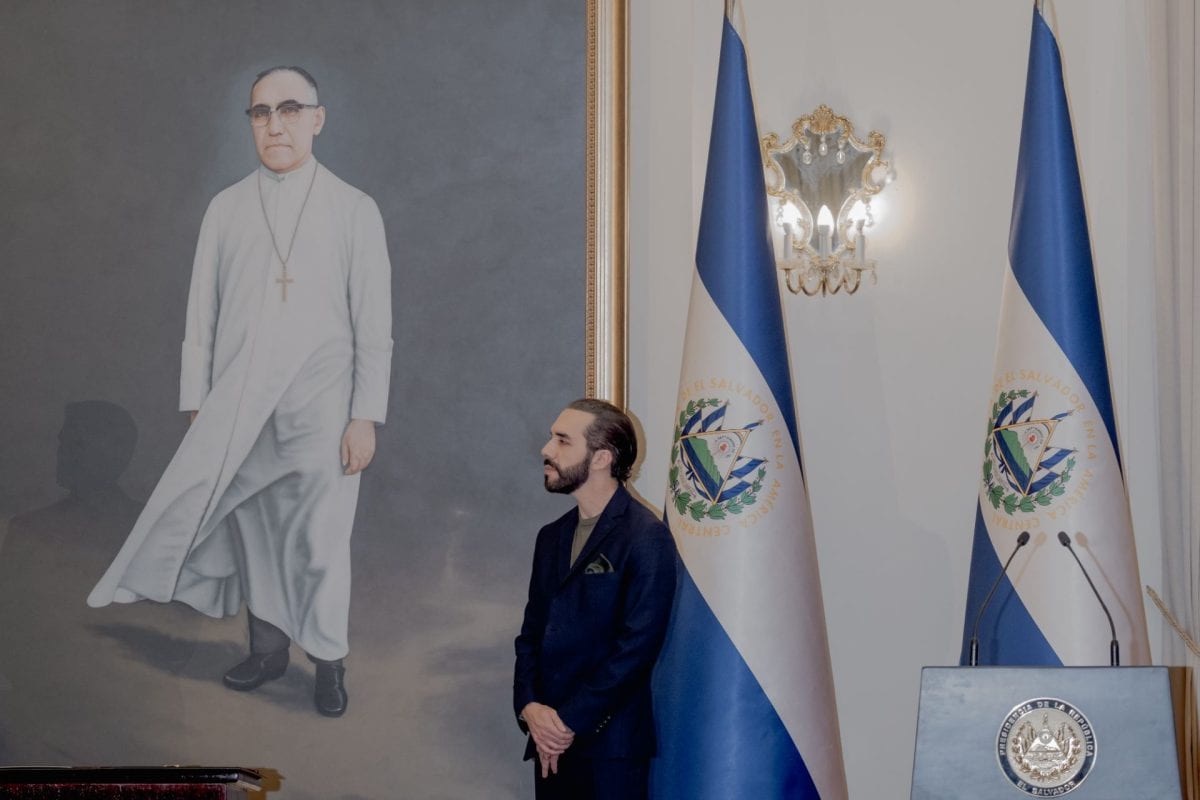
And so, we arrive at the hypocritical image of above: Bukele ruling next to a painting of Oscar A. Romero, an archbishop assassinated for his relentless opposition to the militarist regime during the civil war. A symbolic figure for human rights and justice, particularly for the poor, he provided shelter, food and medical assistance and became ‘a Voice of the Voiceless’ in his widely listened to weekly radio broadcasts and sermons. But Romero’s message has remained encapsulated by the Civil War, unable to serve as reminder today of the violence Salvadorans have suffered under oppressive regimes. Alongside their memory of the civil war, Romero’s efforts have gone in vain as they champion, with an 83% re-election (5), Bukele into his third year in a ‘state of exception’, revoking basic human rights and gradually solidifying his militarist authoritarian rule. Romero’s message, once a voice for the oppressed, now remains trapped in murals and paintings.
The tainted, almost erased memory of the civil war can be understood via Renan’s “doit avoir oublié” – the need for nations to forget certain histories. Memories of the civil war did not serve postwar regimes and parties in their refusal for accountability and fight over postwar narratives, and today they threaten Bukele’s anti-establishment, pro-authoritarian agenda. El Salvador’s forgotten history has allowed Bukele’s rise to power and risks repeating patterns of violence. For their national narratives it’s crucial Salvadorans forget because memory does not only serve to remember past wrongs but is crucial to create futures where these wrongs are not repeated; futures where Salvadoran memory and reckon with their history inspires a fight for democracy and human rights.
Bibliography:
- Renan, Ernest. Qu’est-ce qu’une nation? Lecture at the Sorbonne, 1882. https://www.presselibre.fr/wp-content/uploads/2021/11/Renan_-_Qu_est-ce_qu_une_Nation.pdf
- Bukele, Nayib. (@nayibbukele). “El Dictador más cool del mundo mundial.” X (formerly Twitter), September 21, 2021
- Maldonado, Carlos S. “El Salvador Anula La Conmemoración de Los Acuerdos de Paz Que Pusieron Fin al Conflicto Armado.” El País, January 13, 2022. https://elpais.com/internacional/2022-01-13/el-salvador-anula-la-conmemoracion-de-los-acuerdos-de-paz-que-pusieron-fin-al-conflicto-armado.html.
- Bukele, Nayib. Discurso a La Nación, Por 4 Años de Gobierno. 2024. www.google.com/url?sa=t&source=web&rct=j&opi=89978449&url=www.youtube.com/watch%3Fv%3DXTUAwOqEdZY&ved=2ahUKEwjY586zwKqLAxWmUKQEHbFzEBwQtwJ6BAgMEAI&usg=AOvVaw3-b8-DXKEv_9buuun1tCEr.
- BBC. “El Salvador’s President Bukele Wins Re-Election by Huge Margin.” BBC News, February 5, 2024, sec. Latin America & Caribbean. https://www.bbc.co.uk/news/world-latin-america-68196826.
Featured Image:
Ramos, Fred. President Nayib Bukele Stands under a Painting of Saint Oscar Romero during a News Conference in San Salvador in July 2023. Online Image. The Gallatin Galleries. Accessed November 15, 2024. https://wp.nyu.edu/gallatingalleries/el-salvador-fred-ramos/.
 Identity Hunters