
By Anonymous
Introduction
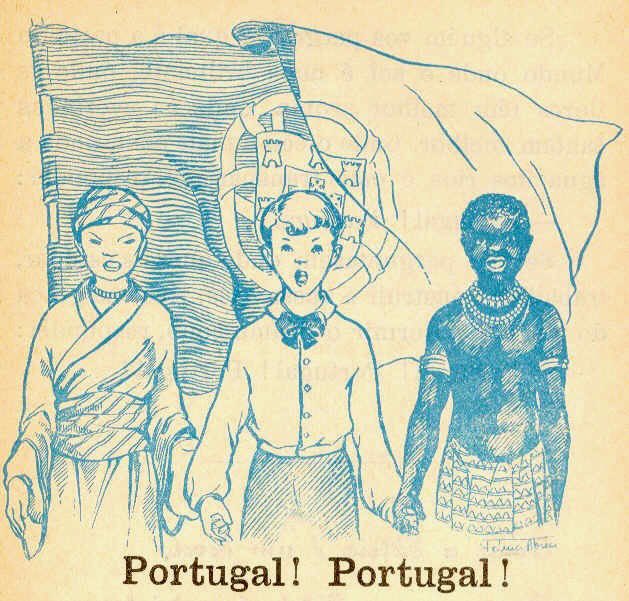
In 1951 the Estado Novo reaffirmed its colonies as overseas provinces, in a gesture that sought to strengthen its claims of a pluricontinental state in the era of decolonization. As Portugal faced mounting pressure from the United Nations to evidence its decolonization, Portugal instead sought to defend its possessions through its theories of Lusotropicalism and Pluricontinentalism.These theories greatly influenced Portugal’s national identity in the Post War period as the nation branded its colonialization as one that was humane claiming that the Portuguese were a people who celebrated intermixing with local cultures because of its diverse ethnic mainland settlers from Moors to Celts. Making the Portuguese have the best attributes as it were to be colonizers in a way that was less repressive than the other European powers. Its territories were justified through the pluricontinental theory that claimed that the overseas colonies were so embedded in Portuguese culture they effectively were core parts of Portugal.
Lusotropicalism
In 1951, Salazar commissioned Brazilian sociologist Gilberto Freyre to study Portuguese territories, setting the stage for propaganda promoting a multiracial society and the rights of overseas subjects. That same year, Portugal rebranded its colonies as “overseas provinces” to emphasize its pluricontinental identity, though governance remained centralized since the 1930 Colonial Act. Freyre’s research culminated in his 1953 book, Um Brasileiro em Terras Portuguesas (A Brazilian in Portuguese Lands), which framed Portuguese colonization in Africa as a continuation of Brazil’s “humane” colonial legacy. Lusotropicalism, as it became known, promoted the idea that Portugal’s colonialism was uniquely tolerant, characterized by the peaceful integration of different racial and ethnic groups through mutual respect and intermarriage. Although Salazar was skeptical of Freyre’s emphasis on miscegenation, the focus on Christianizing indigenous populations aligned with Estado Novo’s ideology. In 1958, Freyre published Integração Portuguesa nos Trópicos, which solidified lusotropicalism as the political framework for promoting Portuguese imperialism both domestically and internationally.
Pluricontinentalism
During the same period of the overseas colonies being affied as provinces in the 1950s Portugal would adopt a state policy of pluricontinentalism that claimed Portugal was a unitary transcontinental state with overseas provinces. As a core element of its national policy to maintain control over its overseas territories, presenting itself as a unified, multi-continental state. By reclassifying its colonies as “overseas provinces” in 1951, the government aimed to promote the idea that citizens from Metropolitan Portugal to Angola enjoyed the same political and social rights. This approach sought to blur the distinctions between the mainland and colonies, portraying Portugal as a diverse but cohesive nation. To support this vision, Salazar commissioned Brazilian sociologist Gilberto Freyre in 1951 to research Portuguese territories. Freyre’s work formed the basis for propaganda promoting a racially integrated society, reinforcing the narrative that Portugal’s colonialism was uniquely humane and beneficial. Through pluricontinentalism, Portugal attempted to justify its empire, positioning its territories as integral parts of the nation while attempting to minimize racial and colonial tensions, even as inequality persisted.
Portugal on the World Stage
The other aspect of Portugal’s development in its identity was its idea of ‘big Portugal’ which saw Portugal trying to humanize its colony past and ensure the preservation of its territory. Especially during the decolonization happening in the post-war period, Portugal with its membership to join the United Nations granted in 1955 and North Atlantic Treaty Organization in 1949, the Estado Novo wanted to try to have a seat at the table with the European powers. As Salazar believed Portugal had consistently been overlooked by its European counterparts since the 1880s through prejudice towards the Portuguese and its global standing. Thus, by reforming into a unitary overseas structure, it sought to embolden territory preservation, and this became a point of national pride that these colonies would not be lost as evidenced through his speech “Portugal is one and unpartable, from Minho to Timor” in similar sentiment as the “The sun never set on the British Empire”.
Impact on Portuguese Identity
Portugal’s national identity has been shaped by colonial ideals like lusotropicalism and pluricontinentalism, both reinforced under Salazar. Pluricontinentalism framed Portugal as a single, multi-continental nation to justify colonial rule, masking racial inequalities under the illusion of unity. This ideology sustained conservative white dominance while marginalizing Afro-Portuguese communities. Despite increased diversity, Portugal’s democratization failed to bring radical change, leaving racial issues unresolved. The abolition of race-based census tracking further obscures these dynamics. Since joining the EU and UN, Portugal has been pressured to amend colonial-era laws, with major changes occurring in the 2000s. However, racism remains deeply embedded, subtly persisting through the duality of lusotropicalism. This reflects the white dominance instilled by Estado Novo, which manipulated Portugal’s historical and global narrative.
 Identity Hunters