
Identity Politics in Pakistan: Blasphemy, Persecution of Minorities and the Apparatus Making it all Possible
Written By Advait Joshi
Pakistan has, for the vast majority of its existence, performed quite poorly on minority rights. While M.A Jinnah claimed upon its inception that “you may belong to any religion or caste or creed… we are all equal citizens of one state”, the nascent nation-state was quick to abandon the ideals of its visionary founder. Today, it seems as if it couldn’t be any further away from what Jinnah must have
envisioned for his people.
This article evaluates the relationship between identity (or weaponisation thereof), the state and rights (or deprivation thereof) in Pakistan, briefly studying the evolution of anti-minority policy since 1947, followed by the status quo and what lies in wait as the country’s financial troubles worsen.
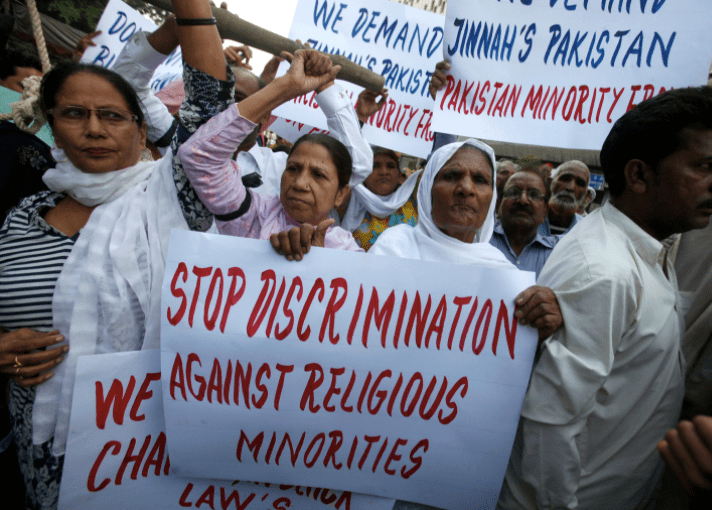
Pakistan’s policy was not always inherently hostile towards minorities. In Jinnah’s eyes, while Pakistan was representative of a Muslim right to self determination, it was not exclusively for Muslims, as he articulated in his first speech as independent Pakistan’s first Head of State. What unfolded, though, was quite different. This discrimination manifested itself in two forms: the state-sanctioned war on Ahmadiyyas, and the systemically-supported persecution of other religious groups, such as Hindus, Sikhs, Christians, Buddhists and Jains.
State-sanctioned war on the Ahmadiyyas
This story took two major southward turns, about three decades apart. The first was in 1953, when an All-Pakistan Muslim Parties Convention demanded the designation of Ahmadiyya Muslims as non-Muslim and their removal from significant government offices. The government’s failure to comply with this led to widespread protests, hundreds dead and nearly three months of martial law. The second, and perhaps more significant, was during the 1980-1986 period, when General Zia ul Haq attempted to codify blasphemy laws as a part of his wider “Islamisation” policy. Under the policy, Ahmadiyya Muslims were essentially declared impostors, “posing as Muslims”. They were expressly forbidden from calling themselves Muslims, praying at non-Ahmadiyya mosques, or from practicing their faith, which involves following an “alternative prophet”, not Mohammed. Any public statements detracting from standardised Islamic belief was subject to
blasphemy provisions, and hence punishable by death. This was problematic for a number of reasons- in addition to becoming the only Islamic state imposing a narrow definition(or any definition at all) of who is a Muslim, they also claimed the authority to conversely decide who wasn’t allowed to practice this faith. These ordinances effectively took away the freedom to practice religion, or the right to an
opinion, or a simple disagreement on religious interpretation. In the years following these ordinances, up to 3,000 people have been accused of the crime and prosecuted, with the accused mainly belonging to the Ahmadiyya, but also the Christian, Hindu, Jewish, Sikh, Buddhist and Jain communities.
The more pertinent, more dangerous byproduct of these ordinances has, however, been the fact that they have emboldened organisations like the Tehreek-e Labbaik Pakistan(TLP) to undertake extremist vigilante activism against alleged blasphemers and mete out public justice, pre-empting the Pakistani legal system. The Asia Bibi case is a significant example. While Bibi remained in judicial custody and was
eventually allowed to leave the country, those who supported her paid the price. This includes Salman Taseer, the erstwhile governor of Punjab and a significant campaigner against the blasphemy laws, who was shot and killed by his own bodyguard for his support of Bibi. Even ministers are not immune to the TLP’s wrath, as is evidenced by the assassination attempt on erstwhile Interior Minister Ahsan Iqbal, accused of being lax on anti-blasphemy legislation. The TLP also
occasionally combines religious fervour with populist issues, conducting massive, usually incredibly violent protests, as they did in 2021. These policies, combined, give the TLP a support base which, while not polling well, constitutes a significant number of extremists who will go to great lengths to protect their vision of the state,
religion and rights, fuelled by an inherent hatred towards any religious groups not aligned with the Sunni orthodoxy.
Wider Persecution of Minorities
The Blasphemy question, severe as it is, makes up only one part of the larger problem, which is the general creation of a hostile environment for anyone not broadly subscribed to the Sunni Orthodoxy.
The US State Department’s 2022 report on Religious Freedom blames the situation affecting religious minorities on the state, detailing a number of mob attacks which targeted and killed Hindu, Sikh, Christian and Ahmadi Pakistanis throughout the year. The report also detailed a number of concerted efforts to forcibly convert religious minorities to Islam by means of “societal harassment, discrimination and threats of violence directed at members of religious minority communities, especially Hindus and Christians”. Another worrying trend covered by the report details the “increasing frequency of attempts to kidnap, forcibly convert and then forcibly marry young Hindu and Christian women”.
In addition to their portrayal as “infidels” by extremist organisations, the broader outlook on life for minorities in Pakistan seems quite bleak. While the state does not actively, or officially, perpetrate the aforementioned atrocities, they are toothless in their response, very rarely, if ever, punishing the groups responsible for these crimes. As is the case in a great number of ethno-nationalist discourses, Pakistan
relies on the sociological construction of in-groups, in this case Sunni Muslims, being at the top of the hierarchy. Conversely, Hindus, Sikhs and other minorities, constituting the “out-group” are not afforded the state protection they so desperately need. In a great number of cases, their rights are actively impeded upon by the state by virtue of them constituting an out-group. This weaponisation of identity has been a great driver behind the successive years of dwindling minority
population rates. For instance, having constituted a fifth of Pakistan’s population in the years after Independence, Hindus now constitute a mere 1.4% of the Pakistani population. This drastic change is incredibly unlikely to occur in a situation where the government protects its minorities’ rights, and in the Pakistani case, the state has
simply failed, maybe even willingly so, to fulfil these obligations.
Conclusion: What Next?
When crises such as these unfold in a country, the natural reaction is to try and decipher the causes. It is also somewhat commonplace for politicians to find electoral gains in these crises. What sets the Pakistani case apart is the general lack of political will for political groups to ‘fix’ these issues, because every single party profits from them, and their removal would entail political losses. Blasphemy,
particularly, is not a politically profitable thing to solve, and this does not bode well for the ethnic and religious minorities that populate, albeit sparsely, Pakistan’s demographic today.
As Pakistan wades deeper into economic trouble, the perceived “other(s) within” become even more prone to persecution, with a constitution that explicitly restricts the rights given to Pakistan’s minorities. While it is incredibly unlikely that they receive it, in order to even survive in Pakistan, these minorities desperately need for the state to change course on policy and urgently guard minority groups’ rights to life and religious freedom.
The case of Pakistan is more confusing and complex than perhaps any other one in the Subcontinent. Populist politics and popular discontent on socio political issues prevail, making reformation of Blasphemy laws and anti minority provisions difficult. To make matters worse, the state has a small, but very violent, rabidly communal Right Wing, comprising groups such as the Tehreek-e-Labbaik Pakistan(TLP) that are willing to kill to maintain these oppressive laws. Make no mistake: this case of constitutionally guaranteed persecution is a significant benchmark that no country
should ever want to breach.
The only solution, in such a situation, seems to be non-political. In a country like Pakistan, prosperity seems to be the most likely bane of divisive communal politics. For the sake of Pakistan’s wider populace, and of course their minorities, this prosperity couldn’t arrive any sooner.
Bibliography
- US State Department: 2022 Report on International Religious Freedom: Pakistan. Link: https://www.state.gov/reports/2022-report-on international-religious-freedom/pakistan/
- Hussain, N., Khan, A., & Chandio, L. A. (2023). Legal Safeguards against Mob Justice: An Analysis of Blasphemy Laws in Pakistan and International Human Rights Norms. Al-Qamar, pp.23.
- Yilmaz, I., & Shakil, K. (2022). Religious Populism and Vigilantism: The Case of the Tehreek-e-Labbaik Pakistan
- Sabat, A., Shoaib, M., & Qadar, A. (2020). Religious populism in
Pakistani Punjab: How Khadim Rizvi’s Tehreek-e-Labbaik Pakistan
emerged. International Area Studies Review, 23(4), 365-381. - Jenichen, A., & Deka, T. (2023). An Intersectional Perspective on
Blasphemy Laws: A Case Study of Pakistan. - Wani, A.(2021) “Pakistan: Minorities under Imran Khan Government”. Observer Research Foundation
- Ispahani, F. (2021) “Imran Khan has Normalised Prejudice in Pakistan” The Diplomat. Pp.2
- Rizwan, M., & Butt, S. (2023). PREDICAMENT OF THE MINORITIES IN PAKISTAN: A PASSAGE TO BIFURCATION. International Research Journal of Religious Studies, 3(1), pp.23.
- Haider, A., & Zaheer, M. A. (2023). Pakistan: A Historical Journey of Religious Nationalism and Political Transformations. Insights of Mystical, Spiritual and Theological Studies, 2(7), pp.32.
 Identity Hunters