
Video Essay by Isla Galloni
Through its spectacular living-representations and decors, the Puy-du-Fou themepark has infused French history with renewed attraction. Its creator, Philippe de Villiers, endowed it with a “unique” mission: to transmit “eternal” emotions. Whilst this signals deeper political implications, Puy-du-Fou’s relation to nationalism remains understudied. Dismissing it as entertainment, current research ignores the quasi-fanatical violence waged against Puy-du-Fou’s critics – “traitors” to French history.
Under this facade of amusement lurk darker nationalist ambitions: through medieval romanticism, Puy-du-Fou binds French identity to blood, Catholicism and a hierarchy perpetuating birth-culture and integral nationalism. Its fantasy casts “extrême-droite” as France’s righteous leader. Cultural and racial exclusion guarantee a return to a nation that has never existed; that will never come.
*
For Pugin, Gothic medieval romanticism reflected a primordial Christian civilisation underpinned by moral supremacy, hierarchy, and “unity of purpose” between cathedral-builders and artists. Puy-du-Fou replicates this through three aesthetics: Folklore, Nature, and Chivalry.
SOT retraces the birth of French medieval romanticism through Christian folklore. Romans are barbarians wrought with cruelty: centurions wear dehumanising masks recalling the gold of their
“fabricated” idols. Black armour signals their inner darkness, a primitivity attached to miscreancy. Gauls embody Pugin’s proto-medieval fantasy: sky-blue costumes indicate moral purity. Their God of “love, justice and charity” is real, holding normative supremacy over barbaric “blood-religion”. This hierarchy echoes Pugin’s “medieval authenticity”: cathedral-builders, united under “glorious Christian
purpose”, are morally-superior to heretics. Clashing aesthetics typify cultural differences assigned to national identities, perpetuating this hierarchy: Christian identity is eternally great, pagan Others are
eternally barbaric. French identity is cultural: to be French is to be Christian, in normative supremacy against non-Christian Others.
Damian seemingly emerges from Gaul consensus: forced to gaze up to Roman tyrants, Gauls resemble a bottom-up revolution united behind their leader. The “heroic individual”, brought forth by populist will, implies a hierarchy within. Normative supremacy is underpinned by a moral order inherent to class, which Puy-du-Fou circumvents by emphasising Damian’s immanent “righteousness” over his centurion rank. To Pugin, “organic development” required wilful hierarchisation of cathedral-builders under a “heroic individual”, the artist. Gauls become a romantic mass moved by national Will: to unite under Damian, their King. If this Will is immanent, then it is always what French identity wants, a societal harmony to which it must return: Maurras’s integral nation under the Noble.
SOT follows a narrative-scheme shared by all Puy-du-Fou representations: pre-existing Christian harmony is destroyed by non-Catholic Others. Divine/monarchical power eliminates invaders; true
civilisation is restored. Whilst violence against the French is barbaric, violence against non-Catholics is legitimate because it restores the “righteous” nation. Repetition creates a cultural permanence derived from historical determinism: Puy-du-Fou’s avoidance of tales of defeat demonstrates that Frenchness is constantly struggling against non-Catholic Others, but always triumphant under the Noble.
*
Pugin ties national glory to “medieval authenticity”, which Puy-du-Fou replicates through Nature. Damian is the rightful King of Gauls because Gaul by birth. Primordial Gaul blood legitimises his claim over land: Mont-des-Alouettes is his by birthright. Roman masks enable Puy-du-Fou to avoid discussing race whilst implying biological divergence. All actors are white, yet the gold prevents any ethnic similarities – different bloods, attached to different territories, signal different and incompatible biological identities.
Land is Gaul, and by extension, French. SOT’s stadium removes its audience from Nature. To Viollet-Le-Duc, Roman architecture reflected a trampling of Gaul land: stadiums “remained Rome’s
monuments”, destroying authentic Gaul environments. Romans are biologically incompatible with French territory. Harmony between Neo-Romanesque decors and Nature symbolises the emergence of
French civilisation from land-itself, a primordial claim to “nation-as-territory”. Puy-du-Fou’s location in a “century-old forest” enables visitors’ reconnection with land considered theirs by birth.
Representations open with reminders of primordial bonds between Puy-du-Fou and animals. The Roman empire’s artificiality is demonstrated by its animal-parade: Roman geese, Egyptian ostriches,
“Oriental” camels – Romans share no real connection with fauna. In contrast, Puy-du-Fou’s “Conservatory”, a “refuge” for (wholly-fantasised) ancient French breeds, cements primordial relations between French identity and their animals. Fauna contributes to sublimation: they are vessels for miraculous destinies, tied to Catholicism. Damian’s quadriga, driven by white horses, miraculously wins; white lionesses refuse to harm his wife. Sublimation interweaves land and spirit, recalling Barrèsian terroir. Nature recognises a righteous French identity bound to birth and culture.
*
SOTS nuances French birth-culture by denouncing an “Other-Within”. The citadel is invaded by race-traitors: despite their blood, Bourguignons use Catholicism to deceive Marguerite. They become Maurras’s “étranger-de-cœur”, highlighting the necessity of both birth and Catholicism in composing French identity.
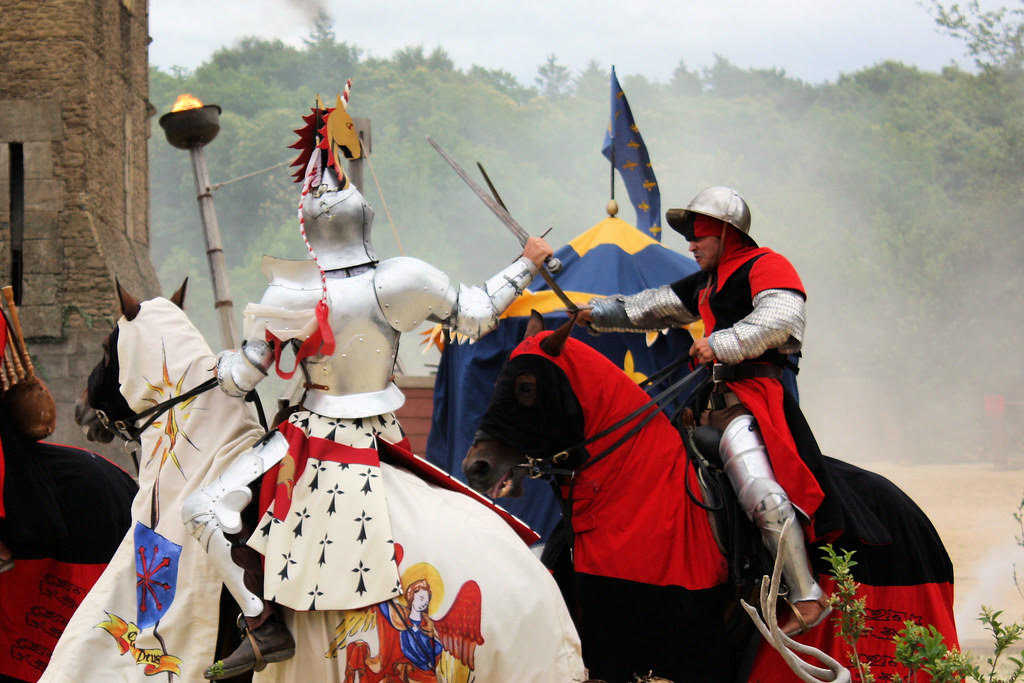
SOTS retraces a historical continuity underpinned by biological determinism: Puyfolean knights must “save the kingdom”. Their warrior-destiny, to sacrifice themselves for the nation, is pre-
determined by gender. They perform their masculinity through equestrian acrobatics, demonstrating an “active male spirit” synonymous with high-risk action whilst Marguerite stands idle. Their return in caparisons signifies that violence grants them social mobility, revising Maurras’s hierarchy. By defending the integral nation, knights are granted recognisable identities tied to class. French men must follow their gendered national duty, granting them limited mobility under the Noble.
SOTS characterises female biological determinism as defencelessness and reproduction. To De Villiers, Joan is not a “warrior” but the “Maid of Orléans”. Marguerite replicates this gendered divide: she is associated with the innocence of sheep and flutes, clashing against knights’ rhythmic music. Her fragility, first highlighted by Fulgent, is interiorised. These descriptions mimic child-like vulnerability, rendering Marguerite dependent on male protection. Through these “protector-roles”, knights become inherently entitled to female bodies: violence gets them the damsel. The romance between Marguerite and Fulgent hints at her reproductive duty to the Nation; a belief Puy-du-Fou cemented through their 50.000€ donation to an anti-abortion association. National unity is maintained by performing gendered duties.
*
Mandelbaum’s nationalist fantasy is a three-part mechanism introduced by an ontological void: a split in identity between nation/state fuels an endless search for resolution. French ethnic-
survivalist theories reflect Barrèsian anxieties: cultural change corrupts French identity and hinders pre-determined triumph. Fear of banlieues echoes Pugin’s modern-day “aesthetic decline”: amalgamations of different architectures and faiths deface the nation. For De Villiers, France is a “society ravaged by globalisation”, whose “disaffiliated beings” perish under invasive architectures, faiths, and by extension, birth-cultures.
The Puyfolean fantasy offers a “national narrative of utopian wholeness” built on phantasmic past unity, “teaching” its audience “how to desire” by setting conditions for its return. Illusive
historical determinism and hierarchies offer order against banlieues chaos. National role and destiny are defined by gender and class (with limited mobility). The Noble will always save you. French identity thus follows an eternal populist will to be hierarchised. De Villiers recalls Pugin in stating: “to be French is to behave like a cathedral-sculptor, leaving his work without leaving his name”. Loss of individuality leads to total homogenisation (without class-conflict) under a “righteous” leader. The crowd must find its Modern Noble: “extrême-droite”, self-claimed “saviours” of French birth-culture.
Puyfolean jouissances create “temporal affective belonging” to Maurras’s integral nation. Puy-du-Fou’s Neo-Romanesque style forges an architectural coherence through which visitors relive a fantasised past unity, away from modern-day cityscapes. It emulates pre-existing jouissances in Neo-Romanesque “églises-de-village”: Catholic harmony experienced during mass is transposed at national level. Sublimation stimulates an emotional apogee interweaving audience’s “bonheur” to
onstage unity. Puy-du-Fou’s scale evokes Pugin’s Neo-Gothicism: its gigantism captures the grandeur of a primordial Christian civilisation. Viollet-Le-Duc stated: “man appears everywhere”. The audience is visible (3.000-7.000 seats) and constantly solicited. During SOT, microphones clamouring “free the Gauls” are dispersed amongst the crowd – spectators seem to directly participate in the representation. The violence of their opposition to the Other elevates them as actors. Like cathedral-builders, they join the “integral nation” – until they leave Puy-du-Fou.
Puy-du-Fou’s cinéscénie depends on 4.000 volunteers operating under Maurrassian hierarchy. Philippe acquires a divine-like quality as the “Creator” of this “puyfolean nation”. Under the supervision of Nicolas and “village chiefs”, Puyfolais re-enact Vendean myth-history for a night. They are moved by populist will to avenge Vendean aristocrats (Nobles) massacred by the 1793-96 Republic (wrongfully deemed “genocide” by Puy-du-Fou). Social mobility from Puyfolais to
employee emerges from their outstanding performances and loyalty. Similarly, Puy-du-Fou Académie forms 360 students in “dancing, horse-riding or fighting” from maternelle to lycée. Their academic
curriculum indoctrinates them into the Puyfolean fantasy, lured by the jouissance of one day becoming Puyfolean employees through their performance of (literal) knighthood.
The Other becomes a necessary explanation for “failing to obtain” the fantasy. Puy-du-Fou demonstrates that French identity is continuously animated by a populist will to be integrated under the Noble. To be hierarchised is to return to security in unity. To reject this hierarchy is to be a race-traitor countering national triumph. Puy-du-Fou inscribes itself in a New-Right “culture-war” against liberal norms assuming equality amongst identities. Violence against Maurras’s “étrangers-de-
naissance” or “étrangers-de-cœur” is necessary to purify French birth-culture. Spectators’ inherent civilisational “light” must push them towards “extrême-droite”, the final rampart of French identity.
*
Interweaving Barrès’s birth-culture with Maurras’s integral nationalism, Puyfolean French identity is immanent to blood and Catholicism, and moved by the metaphysical will to triumph under
the Noble. Rejecting this hierarchy or following liberal assumptions of equality amongst and within identities renders one un-French. By recreating a “golden-age” of societal harmony, the park spurs
violence against those it excludes from French birth-culture.
Equally dangerous is the revival of birth-cultures Puy-du-Fou spreads internationally: following the New-Right coalition against globalised norms, Puy has opened a park in Spain and holds projects in the US and China. Lack of research on Puy-du-Fou’s role in French nationalism is therefore alarming. How much is dismissed as mere entertainment?
Bibliography:
Albertini, Dominique, “Philippe de Villiers écarte l’idée d’une candidature en 2017” in Libération (15th of June 2016)(https://www.liberation.fr/france/2016/06/15/philippe-de-villiers-
ecarte-l-idee-d-une-candidature-en-2017_1459657/, accessed 4th of February 2024).
Baecque, Antoine de, “La Vendée de Jean-Clément Martin” in Mots, Les Langages du Politiques (1992), pp. 118-122.
Besson, Florian; Ducret, Pauline; Lancereau, Guillaume; Larrère, Mathilde, Le Puy-du-Faux -Enqûete sur un parc qui déforme l’histoire (2022).
“Le Puy du Fou raconté par Philippe de Villiers” by C8 (2023)
(https://www.youtube.com/watch?v=TTxPfKAXe2E accessed 2nd of February 2024).
Chedeville, Lucas, “Le Puy du Fou a un discours anti-moderne, anti-Lumières et contre-révolutionnaire” in Street Press (22nd of March 2022) (https://www.streetpress.com/sujet/1647880820-puy-fou-discours-anti-moderne-anti-lumieres-contre-
revolutionnaire-villiers-zemmour, accessed 4th of February 2024).
Clément-Martin, Jean; Suaud, Charles, “Le Puy du Fou: L’interminable réinvention du paysan vendéen” in Actes de la Recherche en Sciences Sociales (1992), pp. 21-37.
Orellana, Pablo de; Michelsen, Nicholas (eds.), ‘Viral Nationalism: The Return of Ethno-Nationalsit Ideas Through the New Right’, in Global Nationalism: Ideas, Movements and Dynamics in the Twenty-First Century (2023).
Durand-Le-Guern, Isabelle, Le Moyen-Âge Des Romantiques (2001).
HTS-Puy du Fou, “Le Secret de La Lance Réalisation Multi-Caméra” (2024) (https://www.youtube.com/watch?v=Nu7fSBD92t0, accessed 4th of February 2024).
“Interview: Philippe de Villiers nous parle du don fait par Puy-du-Fou Espérance à la Fondation Jérôme-Lejeune” on Fondation Jérôme-Lejeune (25th of August 2015) (https://www.fondationlejeune.org/interview-philippe-de-villiers-nous-parle-du-don-fait-par-puy-du-
fou-esperance-a-la-fondation-jerome-lejeune/, accessed 10th of February 2024).
“Complément d’enquête – Histoire, Argent, Pouvoir: les Vrais Secrets du Puy du Fou” by France 2 (September 2023) (https://www.youtube.com/watch?v=UVTRUZ_tRN8 accessed 2nd of
February 2024).
Lagarde, Yann, “Le Puy du Fou: une réécriture du roman national” in France Culture (10th of September 2019) (https://www.radiofrance.fr/franceculture/le-puy-du-fou-une-reecriture-du-roman-national-8039351, accessed 4th of February 2024).
“Mathilde Larrère – Le Puy du Faux – Rencontre à Barricade Liège” (2nd of February 2023) (https://www.youtube.com/watch?v=VwTETePhhUc, accessed 4th of February 2024).
Mandelbaum, Moran, “State, Nation, Society: the congruency fantasy and in/security of the body-national/social” in Critical Studies on Security, vol. 4, no. 2 (2016), pp. 187-201.
Mandelbaum, Moren, “The Repetitions of Nationalism: Ontology, Fantasy, and Jouissance” in De Orellana, Pablo & Miechelsen, Nicholas (eds.), Global Nationalism: Ideas, Movements and Dynamics in the Twenty-first Century (2022), pp.3-22.
Maurras, Charles, Les Conditions de la Victoire – Tome 3 (1915).
Mauras, Charles; Daudet, Léon; Vaugeois, Henri; Montsequiou, Léon de; Moreau, Lucien; Bainville, Jacques; Dimier, Louis; Vesins, Bernard de; Boisfleury, Robert de; Robain, Paul; Delebecque, Frédéric; Pujo, Maurice, “Le Nationalisme Intégral” in L’Action française, vol. 1
(1908).
“Un ‘Damien’ nommé Willy” on Puy du Fou Blog (26th of August 2019) (https://blog.puydufou.com/2019/08/26/un-damien-nomme-willy/, accessed 5th of February 2024).
“Puy du Fou reprend l’anneau de Jeanne d’Arc aux Anglais” on Puy du Fou Blog (4th of March 2016 (https://blog.puydufou.com/2016/03/04/le-puy-du-fou-reprend-lanneau-de-jeanne-darc-
aux-anglais/, accessed 4th of February 2024).
“Top des Idées Reçus sur le Puy du Fou” on Puy du Fou Blog (31st of January 2020) (https://blog.puydufou.com/2020/01/31/top-des-idees-recues-sur-le-puy-du-fou/, accessed 4th of
February 2024).
“Le Signe du Triomphe – Puy du Fou” (2019)
(https://www.youtube.com/watch?v=y5KhJb3Lh1g, accessed 3rd of February 2024).
Le Site du Puy du Fou (https://www.puydufou.com/france/fr/notre-concept, accessed 3rd of February 2024).
Viollet-Le-Duc, Eugène, Dictionnaire Raisonné de l’Architecture Française du XIe au XVIe siècle (1854-1868).
Wilcox, Lauren, Bodies of Violence: Theorizing Embodied Subjects in International Relations (2014).
Wilson, Stephen, “History and Traditionalism: Maurras and the Action Française” in Journal of the History of Ideas, vol. 29, no. 3 (1968), pp. 365-380.
Featured Image: “France VS. England: Le secret de la lance au Puy-du-Fou” (https://www.flickr.com/photos/st3f4n/4793593446).
Illustrations by Emily Lewis & Isla Galloni.
 Identity Hunters