
Written by Mark Sturman
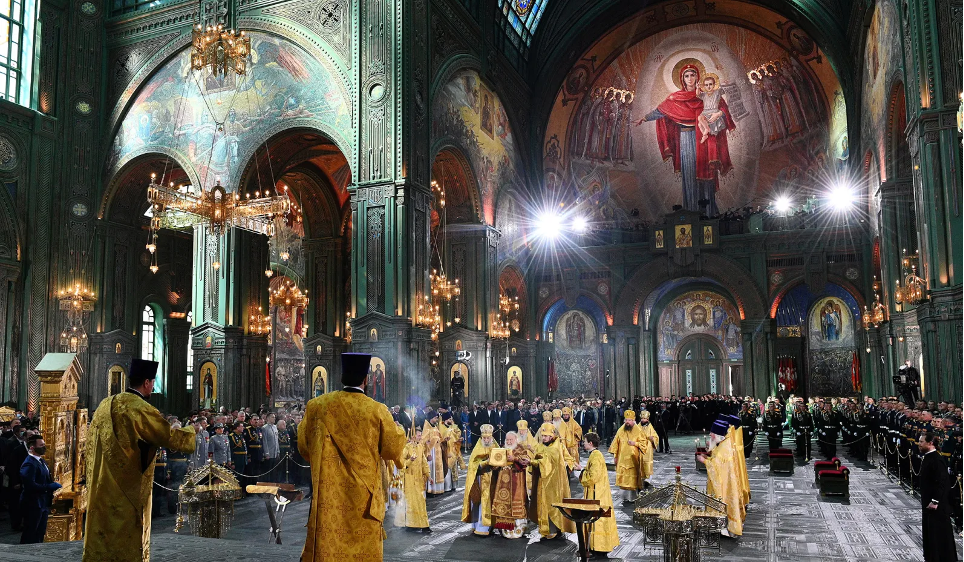
On May 9th 2020, the 75th anniversary of Victory Day was marked in Russia by the completion of a brand-new cathedral commemorating events from across Russia’s military history but with a particular focus on the Great Patriotic War. Its towering edifice sits inside Park Patriot, a theme park set up by the Ministry of Defense that features museums, a firing range and interactive, military-oriented games for the little ones to enjoy. Notable highlights include the current exhibition of war trophies from the fighting in Syria, and a replica Reichstag to be stormed as part of a game of laser tag or airsoft. Although the latter feature undeniably sounds fun, the entire theme park and cathedral complex is a deeply sinister project, made worse by the conscious effort to appeal to children. Minister of Defence Sergei Shoigu makes no secret of the fact that he intended the cathedral to be a place for people to “draw inspiration for serving in our country’s military.” Ultimately, the project promotes a militaristic and revanchist vision of Russia, sanctified by an appeal to religion.
The Main Cathedral of the Russian Armed Forces (Cathedral of the Resurrection of Christ), as it is formally known, is decked from head to toe in martial imagery. The outer walls display bas-reliefs with rows of intrepid Soviet soldiers and T-34’s going into battle while various religious symbols (churches, ikons, orthodox priests in full regalia) bring up the rear. The implication is clearly that the Great Patriotic War was a holy war in which the Soviet armed forces carried out God’s will. This motif is stretched to the absolute limits of credulity, as in one mosaic where an angel bears witness to a religious procession supposed to represent the reintegration of Crimea into the Russian state. This scene appears alongside a representation of the peninsula’s initial annexation in 1783 (also with angelic supervision) to drive home the idea that the events of 2014 were not an opportunistic land grab, but the divinely sanctioned correction of a historical grievance. If Russia and Crimea are bound by heavenly authority, once again, the Russian armed forces and the regime from which they take their orders become instruments in the hands of a higher power. This idea is a central theme which unites the bulk of the artworks contained within.
A short documentary about the cathedral was released soon after it opened, featuring a tour of the interior as well as interviews with some of those involved in its construction and decoration. Before the main door, on which two archangels drive spears into a German Eagle, the presenter gushes that “each time the door is opened and closed, the blade is thrust into the symbol of the Third Reich and cuts it in half.” Even the cathedral has some of the characteristics of an interactive game, building a sense of personal involvement in the triumph over Germany among Russians born long after the event. Again, there is a fusion between military history and religious imagery. The video tries to heighten the religious significance of the project, as multiple interviewees stress its semi-miraculous nature. The chief architect recounts how it was not windy on the day the main dome was due to be installed, and a craftsman explains that some of the stained glass narrowly avoided being lost in a warehouse fire. Both of these events are strongly suggested to have stemmed from divine intervention.
From the outside looking in, such claims are highly outlandish, yet they tie in neatly with a longer-standing tradition in Russian nationalist thought. For a great number of Russian nationalists, the Orthodox Church has represented the spiritual life of the nation as well as a perceived source of Russia’s civilisational distinctiveness when compared with the Islamic world or the Catholic and Protestant West. For many, to be truly Russian is inseparable from being Orthodox, and orthodoxy itself is a truer form of Christianity when compared to other denominations, which are frequently presented as spiritually vacuous or outright atheistic. In this view, the Russian people benefit from a privileged relationship with God and the Russian state takes on a unique, messianic historical destiny that is intrinsically linked to the Orthodox faith. Recent polls suggest that around 70% of the country’s population identify as Orthodox and although the church-going population is far smaller, the simple fact that faith is a facet of Russian identity means that there is a receptive audience for calculated displays of religiosity such as this. The vast scale of the project further plays up the religious aspect of Russian national identity, and paints the regime as a champion of Orthodoxy.
One point of particular interest remains: the inclusion of Soviet imagery in the cathedral’s design. This decision drew criticism from some quarters due to the fundamentally atheistic and anti-religious character of the Soviet state and indeed, there is something quite jarring about seeing a hammer and sickle in the stained glass of a church. It undermines the cathedral’s credibility as a truly ‘orthodox’ project, yet strengthens its appeal to national identity by acknowledging the symbols of a past recent enough for many citizens to remember and identify with.
The Second World War is crucial as an event to which just about the entire population has some relationship, making it well-suited to the creation of a feeling of national unity. Russia is far from the only country in which the question of what one’s ancestors did in the conflict immediately evokes feelings of pride and wonder or shame and regret in most of its residents. Furthermore, the sheer scale of the suffering and eventual triumph of the USSR, and the unmitigated evil of the vanquished foe makes the Great Patriotic War an ideal font of national pride. In recent years, laws have been passed that make it a criminal offence to spread “false information about the Soviet Union’s activities during World War II”, or deny the decisive role of the Soviet military in the conflict. This enables the state to control public discourse surrounding the war and keep it within acceptable bounds conducive to the construction of a positive national feeling. Building on this with regular and extravagant commemorations, the Kremlin aims to accentuate the centrality of a mythologised Great Patriotic War in the minds of the population. The use of language evocative of the Second World War has been a recurring theme in propaganda related to the war in Ukraine, as a political tool to legitimise aggression by casting the enemy in the mould of a recognisable foe. Viewed in this context, it becomes plain to see that the decorations of the cathedral go beyond commemorating the most tragic conflict of human history, and into the territory of glorifying past violence with an eye to present violence.
All in all, the Main Cathedral of the Russian Armed Forces seeks to reaffirm a sense of national selfhood for the post-soviet era by employing an eclectic range of recognisable symbols. It extols the glory of previous military successes, glamorises the sacrifices of those involved and justifies a hawkish foreign policy with reference to historical grievance and religious sentiment. As the regime ramps up its military adventures abroad, the success of the model of nationalism it seeks to propagate and mobilise will likely become apparent in the years to come.
 Identity Hunters